
Table of Contents
The Artificial Intelligence landscape has been defined by speed, scale, and the relentless pursuit of the next acronym. Yet, the late-2025 release of GPT-5.2 Pro and its groundbreaking variant, the “Thinking” model, signals a fundamental shift in the AI arms race. This is no longer just about generating more human-sounding text or processing larger files; it is about injecting genuine, rigorous deliberate reasoning into the core of the model.
OpenAI’s latest move is a direct, high-stakes counter to the momentum Google built with the highly successful, multimodal Gemini 3 series. By dedicating a model variant specifically to complex math, science, and multi-step logic, OpenAI is attempting to carve out a non-negotiable lead in the most critical domain of future AI: cognitive depth. The question before students, engineers, and researchers is whether this new model is a true game-changer that will fundamentally redefine professional work, or merely the next wave of sophisticated hype in a cycle of diminishing returns.
This article delves deep into the architecture, benchmarks, and real-world implications of the GPT-5.2 “Thinking” model, positioning it directly against the multimodal dominance of Gemini 3, and analyzing why “reasoning” has become the definitive battleground of late 2025.

I. Unpacking the GPT-5.2 Architecture: The Mechanism of “Thought”
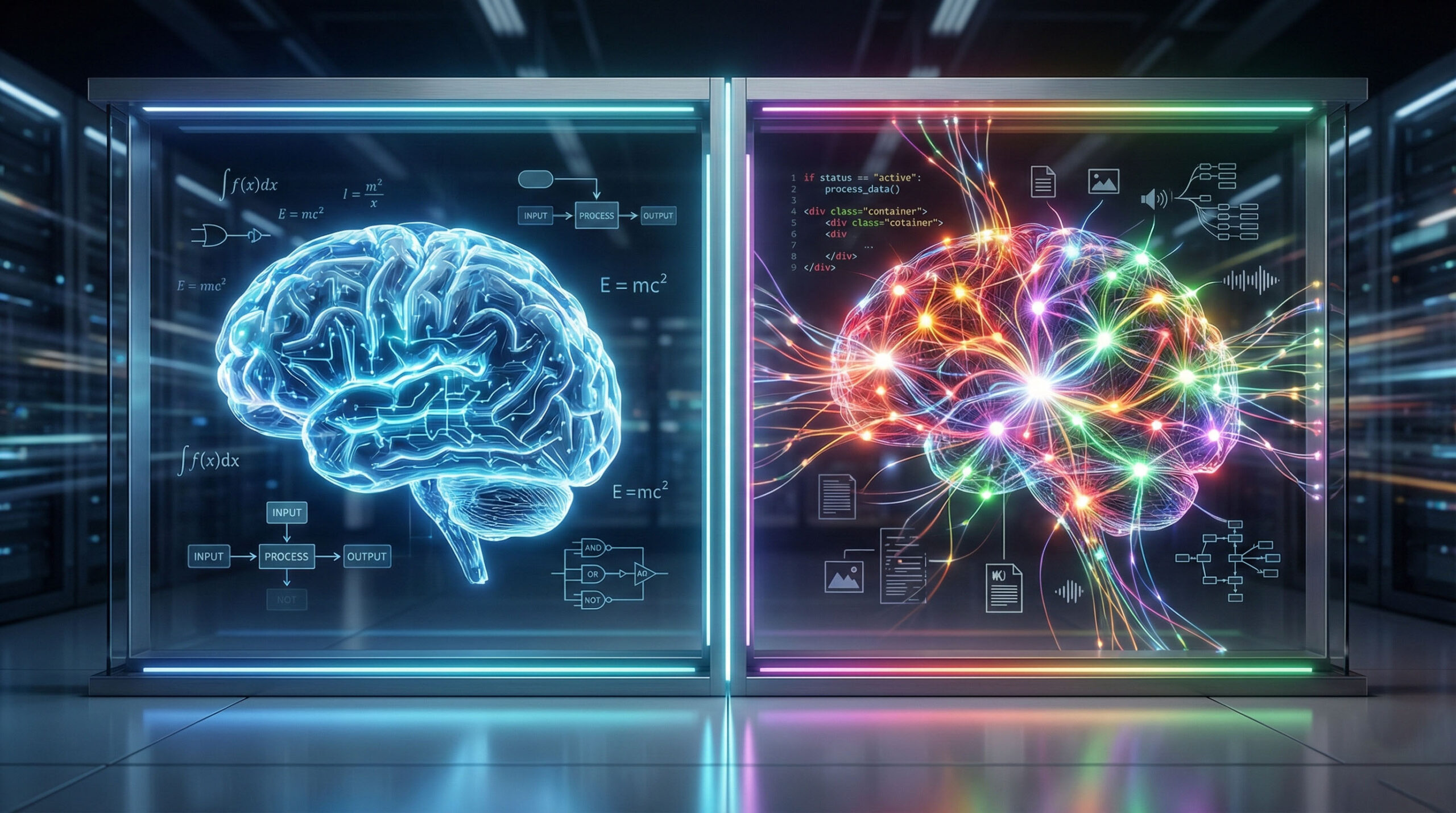
The concept of a language model “thinking” is not a mystical one; it is an engineering solution to the long-standing problem of hallucination and logical inconsistency in complex, multi-step tasks. Previous models, including earlier GPT versions, relied primarily on a “System 1” approach—fast, intuitive, and token-by-token prediction based on statistical probability. This works well for creative writing or simple summaries but fails spectacularly when debugging a complex codebase or solving a PhD-level physics problem.
1. The Core Innovation: Inference-Time Compute (ITC)
The GPT-5.2 “Thinking” model introduces a sophisticated layer of Inference-Time Compute (ITC), an enhanced form of Chain-of-Thought (CoT) reasoning. Instead of generating a single, immediate output, the model dynamically allocates additional computational cycles (and thus, cost) to an internal reasoning buffer before producing the final answer.
The process, which can take several seconds to several minutes for the most complex problems, involves:
- Hypothesis Generation: The model generates multiple potential solution paths internally.
- Path Tracing and Verification: It traces each path against its knowledge base and the explicit logical constraints of the prompt (e.g., mathematical axioms, coding syntax rules).
- Self-Correction Loop: If a path leads to a logical inconsistency or an error (e.g., a mathematical error in step 3), the model prunes that branch and attempts a different approach. This recursive refinement significantly reduces the terminal error rate.
- Final Synthesis: Only the most verified, logically consistent output is formatted and presented to the user.
This “deliberate thinking” process is what allows GPT-5.2 to achieve remarkable scores on technical benchmarks, moving beyond mere linguistic fluency to demonstrating what appears to be abstract comprehension.
2. Model Tier Breakdown
The GPT-5.2 family is segmented into three tiers, targeting distinct user needs:
- GPT-5.2 Instant: Optimized for low-latency, high-throughput daily tasks (quick answers, translation, simple drafting). It retains the foundational speed of a next-gen model with minimal ITC.
- GPT-5.2 Thinking: The breakthrough model for analytical work (coding, math, long-document analysis, financial modeling). It actively uses the new ITC system, which is reflected in a higher per-token cost but delivers vastly superior accuracy on complex tasks.
- GPT-5.2 Pro: The flagship model, designed for enterprise and high-stakes scenarios. It combines the advanced reasoning of the Thinking model with the longest context window available and the highest fidelity for safety, Thinking Model, and instruction adherence. It represents the pinnacle of OpenAI’s current capabilities.
II. The Technical Battleground: GPT-5.2 vs. Gemini 3
The launch of GPT-5.2 positions it directly against Google’s celebrated Gemini 3 Pro and its specialized Deep Think mode, solidifying late 2025 as the year of the reasoning showdown. However, comparing the two models is not a simple matter of feature parity; it is a clash of core AI philosophies.
1. The Reasoning Benchmarks: Depth vs. Breadth
OpenAI explicitly designed Thinking Model the Thinking model to dominate hard, symbolic reasoning, and the initial benchmark results validate this focus:
| Benchmark (Late 2025 Scores) | GPT-5.2 Thinking | Gemini 3 Deep Think | Description |
| SWE-Bench Pro | 55.6% | 48.0% | Real-world software engineering tasks (multi-file refactoring, debugging). |
| GPQA Diamond (Science) | 92.4% | 88.5% | Graduate-level science questions (Physics, Chemistry, Biology). |
| FrontierMath | 88.1% | 80.2% | Advanced, novel mathematical problem-solving. |
| MRCR v2 | 95.1% | 89.9% | Multi-Round Coreference Resolution (Long-context coherence over 200k tokens). |
| MMMU-Pro (Multimodal MMLU) | 71.0% | 79.5% | Multimodal knowledge and reasoning (Text, Image, Chart analysis). |
Analysis:
- OpenAI’s Edge (Logic): GPT-5.2 Thinking is the clear victor in pure logic and symbolic reasoning (SWE-Bench, FrontierMath). Its ITC self-correction loop provides the necessary reliability for intricate, step-by-step problem-solving. Its performance on GPQA Diamond signals a model that genuinely understands abstract scientific concepts at a level previously confined to human doctoral Thinking Model candidates.
- Google’s Edge (Perception): Gemini 3, with its native multimodal architecture, maintains a significant lead in tasks that require integrated perception and reasoning Thinking Model. Its unified context window allows it to analyze a research paper, interpret its embedded charts, and answer questions about both simultaneously, a fluidity that is still more efficient in the Google model.
2. Architectural Philosophy: The Multimodal Divide
- Gemini 3: The Unified Modality: Google’s approach is that intelligence is inherently multimodal. Gemini 3 treats text, images, video, and audio as native data types from the start. This allows for superior cross-modal reasoning—asking it to identify a safety hazard from a video feed based on compliance standards in a linked text document is where it excels.
- GPT-5.2: The Logic Engine with Tool Use: OpenAI’s model remains primarily text-centric but uses dramatically improved internal tool-calling and Thinking Model to handle other modalities. It can analyze images and run code, but it does so by calling internal sub-modules. The core innovation is the reasoning engine, which focuses on optimizing the chain of decision-making before and between tool calls, making the overall agentic workflow more reliable and less error-prone.
III. The Impact: Game-Changer or Hyperbolic Evolution?
The GPT-5.2 Thinking Model is not merely an incremental upgrade; it represents an inflection point in how knowledge work is executed. For high-stakes, analytical domains, it is unequivocally a Thinking Model.
1. Revolutionizing Engineering and Software Development
For engineers, the “Thinking” model is poised to transform the debugging and refactoring workflow:
- Agentic Reliability: The 55.6% score on SWE-Bench Pro means the model can correctly resolve more than half of a real-world software project’s bugs without human intervention. The reliability of multi-file, multi-language refactoring tasks has reached a threshold where the AI can be trusted as a true junior developer or Pair Programmer 2.0, not just a glorified auto-complete tool.
- Complex Tool-Use: GPT-5.2’s stable reasoning is foundational for the rise of trusted AI agents. An agent tasked with cloud infrastructure deployment, for example, must reason about network topology, security policies, and cost optimization across hundreds of pages of documentation. Thinking Model logic ensures the agent follows a consistent plan and can self-correct when an API call fails or a security parameter is violated.
2. Transforming STEM Education and Research
The most profound societal impact will be felt in academia and research.
- The Proactive Tutor: For students, the model is an unparalleled resource. It can break down an abstract concept in quantum mechanics, solve a complex integral, and then explain the conceptual traps a student might fall into—all with a high degree of mathematical certainty. This level of personalized, error-free tutoring in complex subjects was previously impossible.
- Accelerating Scientific Discovery: The ability for GPT-5.2 Pro to contribute to the resolution of previously unsolved mathematical problems (as seen in internal OpenAI case studies) means AI is now an active partner in theoretical research. Scientists are shifting from using AI for mere data analysis to leveraging it for hypothesis generation and formal proof validation. This dramatically accelerates the early-stage exploration that often stalls human research.
- The Ethical Redesign of Assessment: Thinking Model competence necessitates an immediate overhaul of academic integrity and assessment. Traditional take-home exams and problem sets are fundamentally broken when an AI can solve them flawlessly. Educators must now shift assessment to focus entirely on critical application, ethical reasoning, and high-level synthesis—skills that remain uniquely human.
3. Hype Mitigation: The Cost of Deliberation
While revolutionary, the “Thinking” model comes with a significant caveat: cost and latency. The dynamic allocation of Inference-Time Compute means that a complex query that previously took two seconds and cost $0.50 might now take 20 seconds and cost $5.00. This is the new reality of “deliberate thought”—you pay a premium for the model to work slower and be right more often. For routine tasks, the Instant model will remain the default choice, proving that deep reasoning is still a specialized, high-value commodity.
IV. The New Battleground: Reasoning Models in Late 2025
The rivalry between OpenAI’s GPT-5.2 and Google’s Gemini 3 has crystallized the future of AI development. The frontier is no longer about parameter count or data size; it is aboutThinking Model—the ability to exhibit System 2 thinking.
1. The Shift to Cognitive Consistency
The industry is moving from:
- Fluency: (Can it sound human?) $\rightarrow$ Fidelity: (Can it be accurate?)
- Generation: (Can it create content?) $\rightarrow$ Verification: (Can it check its own work?)
The “reasoning model” defines the path to Artificial General Intelligence (AGI). AGI is not just a computer that can talk; it is a system that can reliably reason across modalities, maintain coherence in complex planning, and, crucially, understand cause-and-effect. GPT-5.2 and Gemini 3 are competing to own the foundational logic layer for this future.
2. The Agentic Imperative
The ultimate goal of both major players is to build fully autonomous, highly reliable AI Agents capable of long-running, multi-step tasks in the real world (e.g., managing a budget, executing a complex trading strategy, or designing a physical component).
- Planning and Execution: Agents rely on a high degree of reasoning to adapt their plan when unexpected errors occur (e.g., “The API call failed; I must revert the transaction and try the backup server”). The superior logic of GPT-5.2 Thinking makes it a more reliable engine for these high-autonomy agents.
- The Competitive Threat: The success of OpenAI’s reasoning focus is already triggering competitive responses. Reports suggest Meta is aggressively working on a new model optimized for similar logic-heavy, enterprise-grade reasoning. Anthropic and other labs are also prioritizing explicit reasoning modules, confirming that this is the undisputed, central battleground for late 2025 and beyond.
Conclusion: A Paradigm Shift in Cognitive AI
OpenAI’s launch of the GPT-5.2 Thinking Modelis more than a product release; it is a philosophical statement. By prioritizing deep, reliable, and deliberate reasoning over mere output speed, OpenAI has successfully raised the bar for what enterprise and technical users should expect from frontier AI.
While Gemini 3 maintains a formidable lead in integrated, real-time multimodal processing, the GPT-5.2 Thinking model is currently the most robust tool for pure intellectual labor in science, mathematics, and complex engineering. It is not hype; it is a verifiable game-changer that promises to fundamentally restructure work and learning in STEM fields. The new AI arms race is defined by who can think best, and for now, OpenAI has a highly compelling, if costly, claim to the intellectual crown.

