
Table of Contents
Introduction – Why Hyperautomation Is Redefining the Digital Era
The digital transformation narrative has long been dominated by buzzwords like “cloud,” “agile,” and “automation.” Yet, as we move into the second half of the 2020s, a new, more powerful paradigm has emerged that synthesizes these concepts into a unified, relentless engine of operational excellence: Hyperautomation.
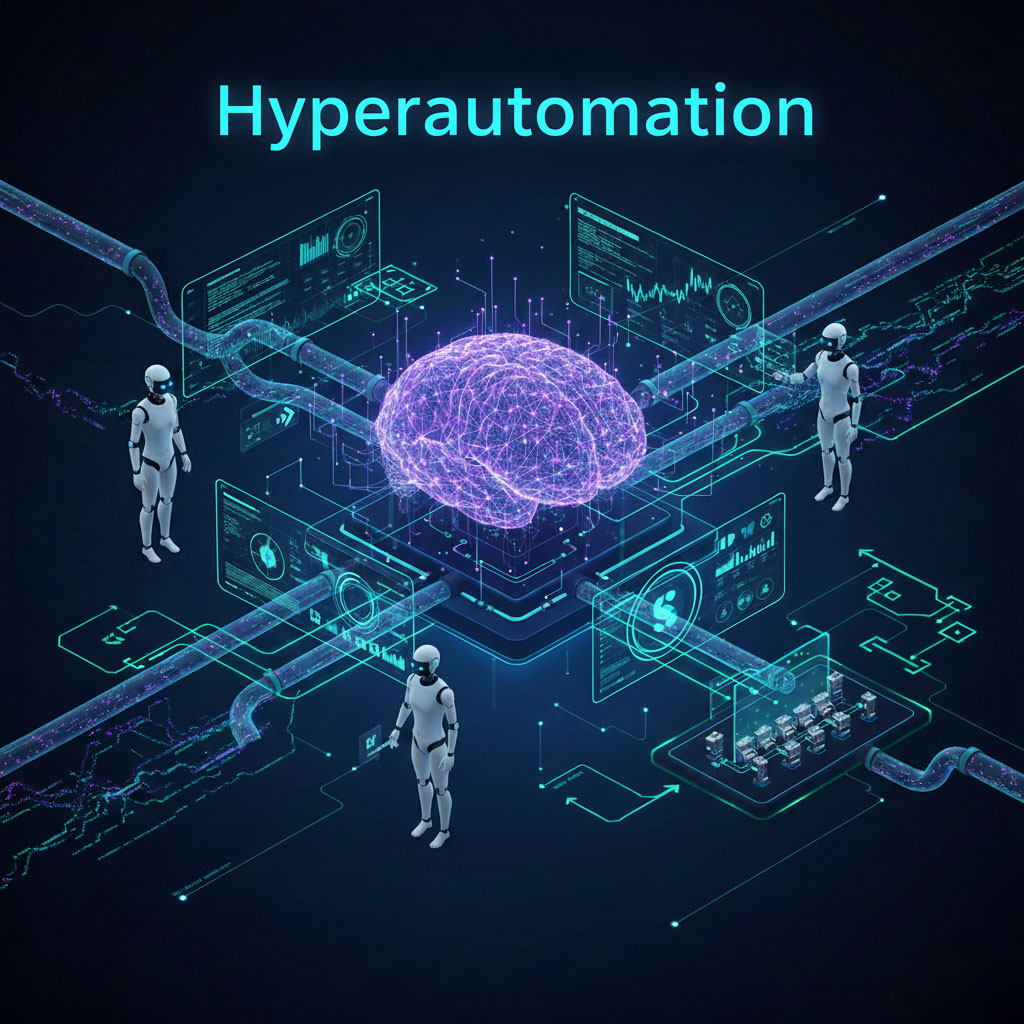
Hyperautomation is more than just a tool or a single piece of software; it is a holistic, business-driven strategy that leverages a coordinated orchestra of advanced technologies to automate as many business and IT processes as possible, as rapidly as possible, and at scale.1 It represents a fundamental shift from automating isolated, repetitive tasks to automating complex, end-to-end workflows that span multiple departments, systems, and data sources.2
The Critical Difference: Traditional vs. Hyperautomation
The core distinction lies in scope and intelligence.
| Feature | Traditional Automation (RPA/Basic Workflow) | Hyperautomation |
| Scope | Single, linear task or simple rule-based process. | End-to-end, complex, multi-system, and cross-functional processes. |
| Technology | Robotic Process Automation (RPA) and basic scripting. | Orchestrated combination of AI, ML, RPA, process mining, intelligent document processing (IDP), and Autonomous Agents. |
| Intelligence | Rule-based, non-adaptive, ‘if-this-then-that’ logic. | Adaptive, self-learning, predictive, and context-aware Decision Intelligence. |
| Goal | Cost reduction and efficiency in specific, high-volume tasks. | Organizational agility, increased business velocity, and strategic decision-making at scale. |
In the traditional model, a bot might automate the entry of an invoice into an ERP system—a task-level success. In the hyperautomated enterprise, an Autonomous Agent powered by AI would use process mining to identify the invoice workflow as a bottleneck, apply intelligent document processing (IDP) to extract data from the invoice regardless of format, validate it against the PO and contract, auto-post the entry, and then notify the finance team via an integrated platform, only escalating exceptions requiring human judgment.3 This is the difference between an efficiency gain and a systemic transformation.
Why It Is Becoming Essential in 2025 and Beyond
The necessity of hyperautomation in 2025 is driven by four undeniable forces:
- Explosion of Unstructured Data: The majority of enterprise data is locked in documents, emails, images, and voice recordings. Traditional, rule-based systems simply cannot process this data. Hyperautomation’s reliance on AI and ML, particularly Natural Language Processing (NLP) and computer vision, unlocks this value, making processes like contract review and customer service fully automated.4
- Pressure for Business Agility: Global market volatility demands that businesses pivot quickly. Automation must move from fixing single pain points to creating adaptive, resilient, and optimized processes that can be deployed instantly.
- The Rise of Agentic AI: The maturity of large language models (LLMs) and specialized reasoning models like DeepSeek has enabled the creation of truly goal-oriented AI entities. These autonomous entities can now handle complex, multi-step problem-solving that was previously exclusive to human knowledge workers.5
- The Scale Imperative: Automation is no longer a small, localized IT project; it is an enterprise mandate. Only an orchestrated, intelligent approach can deliver workflow automation at the scale required to impact billions in revenue, not just millions in cost savings.
Understanding Hyperautomation
Definition and Core Concepts
Hyperautomation, at its core, is the pursuit of “automation of everything that can be automated.”6 This pursuit is achieved through the disciplined, end-to-end integration of several key technologies:
- Artificial Intelligence (AI) and Machine Learning (ML): Providing the intelligence layer for perception, prediction, and self-optimization.7 This is the “brain” that allows systems to handle variations and make non-rule-based decisions.8
- Robotic Process Automation (RPA): The “hands” of the system, handling structured, repeatable tasks by mimicking human interaction with legacy application interfaces.9
- Process and Task Mining: The “eyes” of the system, using logs and desktop recordings to discover, visualize, and prioritize the actual processes that should be automated, not just the ones people think exist.
- Intelligent Business Process Management Suites (iBPMS) and Integration Platform as a Service (iPaaS): The “central nervous system” that orchestrates the flow of data and actions across disparate enterprise applications (CRMs, ERPs, legacy systems) and manages the complex, adaptive workflows.
- Low-Code/No-Code (LCNC) Tools: Enabling “citizen developers”—business users—to participate directly in the creation and maintenance of automations, accelerating development and decentralizing process expertise.10
The resulting hyperautomated process is end-to-end automation: a seamless, digital assembly line where a business outcome, such as “Onboard a new client” or “Close the quarterly books,” is achieved with minimal human intervention, relying on intelligent systems to handle the bulk of the decision-making and execution.
Evolution from Automation to Intelligent Automation
Automation has evolved dramatically from its rule-based origins:
- Mechanization (Pre-1990s): Simple, large-scale systems (like ERP) automating big transactions (e.g., general ledger entries).
- Task Automation (2000s – Early 2010s): Scripting and early tools to automate simple, individual, and linear tasks (e.g., scheduled report generation).
- Robotic Process Automation (RPA) (Mid-2010s): Software bots mimicking a human user interface to automate highly repetitive, rule-based tasks (e.g., data transfer between two legacy systems).11
- Intelligent Automation (Late 2010s – 2020s): Combining RPA with ML/NLP to handle semi-structured data (e.g., using an AI model to classify an email before an RPA bot acts on it).
- Hyperautomation (2025 and Beyond): The multi-tool, strategic, end-to-end orchestration defined above, where the goal shifts from automating a task to creating a self-optimizing business process driven by Autonomous Agents.
Rule-based systems are no longer enough because business processes are inherently messy. They involve interpreting fuzzy data, making judgments based on context, and adapting to real-time events. A classic RPA bot can’t process a contract with an ambiguous clause; an intelligent hyperautomation agent can, thanks to its AI core.
The Role of Artificial Intelligence in Hyperautomation
AI is not just a component of hyperautomation; it is the catalyst that elevates it from simple mechanical repetition to complex, cognitive work.12
Machine Learning and Decision Intelligence
Machine Learning (ML) transforms automation from reactive to predictive. By continuously analyzing vast datasets—from transaction records to sensor readings—ML models identify patterns, anomalies, and future trends that inform and trigger automated actions.13
- Predictive Decision-Making: In manufacturing, an ML model analyzes vibration data from a machine tool (IIoT data). It predicts a 90% probability of failure within the next 48 hours. This prediction automatically triggers a hyperautomated workflow: a work order is generated in the CMMS, the parts team is notified to pull inventory, the production schedule is adjusted, and an alert is sent to the human maintenance supervisor. The decision (when to schedule maintenance) is made intelligently by the system.
- Self-Learning Systems: In customer service, an Autonomous Agent handles a customer complaint.14 After the interaction, an ML feedback loop evaluates the resolution quality, the time taken, and the customer satisfaction score. The agent then automatically updates its own conversational flow or knowledge retrieval strategy based on successful outcomes, leading to continuous, self-optimizing improvement without requiring a new deployment cycle from an IT team.
Natural Language Processing and Conversational AI
Natural Language Processing (NLP) and Conversational AI are the primary tools for unlocking unstructured data and facilitating human-like interaction.
- Document and Data Understanding: Intelligent Document Processing (IDP) uses NLP to read and understand documents (invoices, legal contracts, claims forms).15 Unlike basic Optical Character Recognition (OCR), IDP can extract and classify information based on context, not just location on a page. This capability is vital for automating processes in finance and legal departments, where the volume of unstructured text is immense.
- Human-like Interaction: Conversational AI, embedded as the front-end to hyperautomation workflows, handles interactions with customers and employees.16 This allows users to initiate complex, multi-step workflow automation processes simply by speaking or typing a request, such as, “Please process my PTO request, and ensure my manager and the project lead are notified about my shift in availability.”
Autonomous Agents – The Brain of Hyperautomation
The most significant advance driving hyperautomation today is the transition from static bots to dynamic, goal-oriented Autonomous Agents.
What Are Autonomous Agents?
Autonomous Agents are software entities powered by generative AI (typically LLMs and specialized reasoning models) that can:
- Perceive: Take in and interpret data from their environment (system APIs, databases, documents).
- Plan: Formulate a multi-step execution plan to achieve a defined, high-level goal (e.g., “Resolve the open bug report for System X”).
- Act: Execute the plan by calling external tools, systems, and APIs (e.g., logging into Jira, running a script, sending a notification, or initiating an RPA bot).17
- Reflect/Learn: Assess the outcome of their actions, correct errors, and update their internal planning strategy for future tasks—all without human oversight.
These self-operating AI entities shift the focus from human-centric task design to goal-centric system design. They do not just follow a script; they reason, adapt, and make micro-decisions along the way, essentially functioning as intelligent, virtual employees capable of managing complex, end-to-end processes.18
Use Cases of Autonomous Agents in Enterprises
The capability of Autonomous Agents is transforming core business functions by providing a true digital workforce:19
- Customer Support (The Digital SDR): An agent monitors all social media, email, and chat support channels. It can identify a high-priority complaint, research the customer’s history in the CRM, automatically draft and send a personalized apology email, generate a ticket in the help desk system, and auto-route it to the correct human engineer for final sign-off, thus completing a multi-step process that required data integration and decision-making.
- Supply Chain (The Logistics Planner): A financial agent monitors inventory levels, supplier lead times, and fluctuating commodity prices in real-time.20 If it detects a surge in the price of a critical component, it doesn’t just notify a human; it autonomously reviews alternate, pre-approved suppliers, generates a comparison report using current market data, and initiates a lower-volume, higher-cost order with the alternative supplier to mitigate risk, all within defined budget and compliance limits.
- Finance and HR (Compliance & Onboarding): A compliance agent monitors regulatory changes (e.g., a new GDPR amendment).21 It automatically analyzes the firm’s internal policy documents, identifies all conflicting clauses, and generates an updated policy draft for the legal team’s final review. For HR, an onboarding agent can provision system access, send welcome emails, schedule initial training, and assign a mentor—connecting the HRIS, IT, and communication systems seamlessly.22
Workflow Automation at Scale
Hyperautomation’s power is realized when simple task automation evolves into strategic, enterprise-wide workflow automation at massive scale.23
From Task Automation to Process Orchestration
- Task Automation (The Bot): Focuses on executing a single, discrete action (e.g., logging into an application and copying data). It is siloed and brittle.
- Process Orchestration (The Conductor): Focuses on managing the complex journey of data and work across dozens of applications, systems, and human touchpoints to achieve a macro business goal. This requires robust platforms (iBPMS/iPaaS) that serve as the central nervous system, connecting systems and teams like the ERP, CRM, and bespoke legacy tools. By orchestrating, manual handoffs—the biggest source of friction, delay, and error—are eliminated, ensuring an unbroken digital thread from start to finish.24
Intelligent Workflow Automation Platforms
Modern hyperautomation platforms provide the tools for this large-scale orchestration:25
- Real-Time Monitoring and Analytics: Systems continuously monitor every step of the automated workflow, providing real-time dashboards of performance metrics (cycle time, error rate, cost per transaction).26 Process mining tools analyze this live data to identify new bottlenecks or non-compliant process variations, providing the continuous feedback loop required for optimization.27
- Adaptive Workflows: Unlike static processes, intelligent workflows are adaptive.28 They use ML-powered decision engines to dynamically adjust the path based on real-time data or context. For example, a loan application workflow might automatically divert a high-risk applicant to a human underwriter (due to a flag from an ML fraud model) while routing a low-risk, simple application directly to auto-approval.
DeepSeek and the New Generation of AI Models
The ability of hyperautomation systems to handle complex, end-to-end workflows is directly tied to the sophistication, efficiency, and accessibility of the underlying AI models. This is where models like DeepSeek are having a significant enterprise impact.
How DeepSeek Enhances Enterprise Automation
DeepSeek is a notable player in the modern AI landscape, particularly for its focus on efficiency and advanced reasoning capabilities, often delivered through a Mixture-of-Experts (MoE) architecture.29 This approach provides key advantages for enterprise automation:
- Advanced Reasoning and Logic: Models like DeepSeek-R1 are specifically trained on vast datasets emphasizing logical inference, mathematical problem-solving, and multi-step planning.30 In a hyperautomated workflow, this reasoning power is critical for Autonomous Agents that must design and execute complex, multi-step plans, such as drafting a technical code fix or determining the optimal sequence of actions across disparate systems to resolve a supply chain disruption.31
- Cost-Efficient AI Deployment: The MoE architecture allows the model to activate only the “expert” sub-models relevant to the current task, rather than running the entire neural network.32 This sparsity dramatically reduces computational requirements during inference (the execution of the model), making the deployment of sophisticated AI cost-efficient and faster at scale—a massive advantage for enterprises running thousands of daily automated decisions.
DeepSeek vs Traditional AI Models
The comparison highlights a shift toward specialization, efficiency, and transparency:
| Feature | Traditional LLMs (Dense Architectures) | DeepSeek (MoE Architecture) |
| Architecture | Dense Transformer (all parameters are activated for every task). | Sparse Mixture-of-Experts (MoE) (only relevant sub-models are activated). |
| Speed (Inference) | Slower and more resource-intensive per query. | Faster inference speed due to reduced compute requirements. |
| Accuracy (Technical) | Strong general knowledge, but can be less precise in complex, multi-step logical reasoning tasks. | Exceptional in specialized technical tasks like coding, mathematical and logical reasoning (DeepSeek-Coder, DeepSeek-R1). |
| Scalability & Cost | High computational cost for scaling across an enterprise (GPU-intensive). | High scalability with lower marginal cost per use, enabling wider adoption in cost-sensitive business units.33 |
For enterprises, this means they can embed advanced AI reasoning into more of their automation workflows without prohibitive cloud compute costs, making the full vision of hyperautomation financially viable.
Google AI Studio and Rapid AI Development
Alongside the power of models like DeepSeek, the accessibility of AI development is another key enabler for hyperautomation.34 Google AI Studio plays a crucial role in democratizing this technology.35
Democratizing AI for Businesses
Google AI Studio (often used in tandem with the broader Google Workspace Studio and Vertex AI platforms) is an integrated, web-based environment designed to accelerate the prototyping and building of AI-first applications, making it accessible even to non-specialists.36
- Low-Code / No-Code AI Development: The platform offers visual, drag-and-drop interfaces that allow business analysts and ‘citizen developers’ to experiment with powerful models like Gemini.37 Users can craft complex prompts, chain functions, and test outputs without writing a single line of code.38 This dramatically expands the pool of employees who can contribute to building AI components for hyperautomation.
- Faster Experimentation and Prototyping: Instead of requiring weeks of DevOps setup, a business user can go from an idea—e.g., “build an AI to read client sentiment from email bodies”—to a fully functional, testable model and API endpoint in hours. This pace of experimentation is necessary for enterprises that need to rapidly build, test, and refine hundreds of automation workflows.
Integrating Google AI Studio into Hyperautomation Pipelines
Google AI Studio and its associated APIs integrate directly into the broader hyperautomation fabric:
- Model Training and Fine-Tuning: Business-specific data (e.g., industry jargon, proprietary forms, internal policies) is used within the Studio to fine-tune a base model (like Gemini) for domain-specific accuracy.39 This specialized model is then deployed via a robust API.40
- API-Based Automation: The resulting AI capability (e.g., a custom document classifier or a unique customer support summarizer) is instantly accessible via a simple API call. The hyperautomation platform (iBPMS/iPaaS) treats this API as a “tool” that an Autonomous Agent can call during a workflow automation. This modularity allows for the quick creation of customized, intelligent steps within any end-to-end process.41
Green Computing and Sustainable Hyperautomation
As AI systems become ubiquitous, the energy consumption required to train, deploy, and run them is a growing concern. The ethical mandate for digital transformation must include a commitment to Green Computing and sustainability.
Why Sustainability Matters in AI Automation
- Energy Consumption of AI Systems: Training massive LLMs and running billions of daily inferences consumes enormous amounts of electricity.42 A single, large-scale training run can have a carbon footprint equivalent to a trans-American flight. This environmental cost is not sustainable as AI adoption accelerates across every enterprise.43
- Environmental Impact: Data centers, which house the compute resources for hyperautomation, are responsible for a significant and growing percentage of global electricity consumption. Responsible technology leaders must seek out strategies that couple business efficiency with ecological responsibility.
Hyperautomation as a Driver of Green Computing
Counterintuitively, hyperautomation is one of the most powerful tools for achieving Green Computing goals.44 It allows an enterprise to make its entire operations more efficient and less wasteful.
- Optimized Resource Usage in IT: The principles of hyperautomation—process discovery, elimination of waste, and real-time monitoring—can be applied to IT operations itself. AI-driven agents can monitor cloud and on-premise infrastructure, dynamically scaling down compute resources (servers, GPUs) during off-peak hours, optimizing cooling systems in data centers, and intelligently routing workloads to the most energy-efficient zones.45 The self-optimizing nature of the workflow translates directly into optimized energy use.
- Reduced Carbon Footprint in Operations: Beyond IT, hyperautomation dramatically reduces the environmental cost of physical operations.
- In manufacturing, predictive maintenance (P-M) reduces the need for emergency, high-energy repairs and extends equipment lifespan, minimizing e-waste.
- In logistics, smart logistics agents optimize transportation routes and warehousing operations, reducing fuel consumption and empty miles.
- In finance, the full digitization and automation of document-heavy processes eliminates paper and the energy cost of physical filing, printing, and transport.
Models like DeepSeek’s MoE architecture, with its focus on computational efficiency and lower inference costs, directly contribute to the Green Computing agenda, proving that high-performance AI can also be sustainable AI.46

Industry Use Cases of Hyperautomation
Healthcare
- Diagnostics and Medical Imaging: AI agents analyze radiology scans (X-rays, MRIs) and digital pathology slides, flagging anomalies with greater speed and consistency than a human could achieve alone. This intelligent step automatically initiates a patient workflow, prioritizing the case for the human radiologist’s final review.
- Patient Workflow Automation: An end-to-end workflow can begin with an incoming patient referral (unstructured data), use IDP to extract key medical history, check against insurance eligibility (RPA/API), automatically schedule the correct type of appointment based on the severity and specialty (ML), and send all confirmation and pre-visit forms to the patient.
Finance and Banking
- Fraud Detection and Risk Management: Machine Learning models continuously monitor transaction streams in real-time, identifying complex, non-obvious patterns indicative of fraud or money laundering.47 Unlike simple rule-based alerts, the intelligent system generates a risk score, automatically initiates a multi-step investigation by an Autonomous Agent (which pulls customer history, analyzes communication logs, and checks external databases), and creates a compliant suspicious activity report (SAR) for the human compliance officer to approve—all within minutes.
- Automated Compliance and Regulatory Change: A hyperautomated system ingests all new global and local regulations (unstructured data), uses NLP to cross-reference them against internal policies, and auto-generates a prioritized action list, ensuring near-instant compliance adaptation.
Manufacturing and Supply Chain
- Predictive Maintenance: As covered, AI agents ingest IIoT data from equipment sensors (vibration, temperature) to predict failure before it happens, automatically triggering the maintenance and parts ordering workflow automation, minimizing costly downtime.48
- Smart Logistics and Inventory: Autonomous Agents use real-time market data, weather reports, and freight capacity information to dynamically adjust shipping schedules and inventory stocking levels.49 The agent not only predicts optimal reorder points but also executes the entire purchase order process, from vendor selection and price negotiation (within pre-approved limits) to final payment processing.
Business Benefits of Hyperautomation
Hyperautomation is not simply a technical upgrade; it is a fundamental pillar of the Intelligent Enterprise.
- Cost Reduction: By automating end-to-end processes, hyperautomation drives savings far beyond the singular task.50 It reduces error rates (fewer costly reworks), eliminates process friction (faster cycle times), and allows for flat organizational growth (scalability without proportional headcount increases).51
- Speed and Efficiency: It enables business velocity. Processes that once took days (e.g., loan application approval, expense report reconciliation) are completed in minutes, drastically improving cash flow and customer experience.
- Better Decision-Making: The embedded AI, ML, and Autonomous Agents provide Decision Intelligence.52 Actions are no longer based on intuition or static rules but on real-time, high-context, data-driven predictions and insights, leading to superior, consistent business outcomes.
- Scalability and Resilience: The digital workforce can scale up or down instantaneously to meet demand fluctuations (e.g., peak holiday order volumes) and operate 24/7/365, building unprecedented operational resilience.
Challenges and Risks of Hyperautomation
The journey to a fully hyperautomated enterprise is not without significant strategic and ethical hurdles.
Data Security and Privacy
- AI Governance and Data Trust: Hyperautomation systems touch every sensitive part of an organization. This requires rigorous AI governance frameworks to ensure the models are fair, unbiased, and auditable. Poorly governed agents can inadvertently expose sensitive data or make decisions based on flawed, biased training data, leading to legal and reputational damage.
- Compliance Issues: Managing data access and process execution across multiple global systems mandates strict compliance with regulations like GDPR, HIPAA, and various financial regulations.53 The lack of a clear audit trail in complex, multi-agent systems is a massive risk that must be mitigated by building governance and security directly into the orchestration layer.
Skill Gaps and Organizational Resistance
- Workforce Transformation: Hyperautomation does not eliminate jobs; it re-skills them. The focus shifts from executing repetitive tasks to designing, governing, and collaborating with the digital workforce. There is a critical, immediate need for new roles like AI Governance Managers, Automation Architects, and Autonomous Agents Supervisors—a skills gap that must be urgently addressed.
- Change Management: Organizational resistance from employees who fear being replaced is a primary adoption barrier. A successful rollout requires transparent communication, robust re-training programs, and positioning the digital workforce as a partner that frees human workers to focus on creative, high-value, and strategic work.

The Future of Hyperautomation
Hyperautomation + Agentic AI
The next phase of hyperautomation will be defined by fully Agentic AI. This will move beyond simply having an agent execute a pre-defined workflow to having a dynamic team of cooperating agents manage an entire business domain.
Imagine a “Chief Finance Agent” responsible for the P&L of a subsidiary. This agent would autonomously task and supervise a “General Ledger Agent,” an “Accounts Payable Agent,” and a “Forecasting Agent.” The CFO would interact with the Chief Finance Agent, which would synthesize complex data, provide real-time strategic recommendations, and autonomously execute the required changes across the business systems. This vision points toward a fully autonomous enterprise, where humans set high-level strategic goals, and the AI agents determine the best plan and execute the operational details.
The Road Ahead (2025–2035)
- Prediction 1: The AI Broker: By 2030, a new layer of software—the AI Broker—will emerge to manage and optimize calls between different AI models (like choosing the most cost-efficient DeepSeek model for one task and a highly accurate proprietary model for another), dynamically ensuring compliance, cost, and performance.
- Prediction 2: Green AI Mandates: In line with the need for Green Computing, regulations will mandate energy efficiency metrics for all large-scale AI deployments. Enterprises will prioritize MoE and other sparse models to meet sustainability targets.54
- Prediction 3: Hyper-Personalization: The ability of AI to understand context will lead to hyper-personalized, one-to-one customer and employee experiences that are fully automated from discovery to resolution, blurring the line between digital and human interaction.
Conclusion – Hyperautomation as the Foundation of the Intelligent Enterprise
Hyperautomation is the inevitable destination of digital transformation. It is the sophisticated, multi-layered framework required to tame the complexity of the modern enterprise, where unstructured data, legacy systems, and global scale collide. By intelligently orchestrating technologies like RPA, ML, and specialized models like DeepSeek and leveraging the accessibility of tools like Google AI Studio, businesses are moving from simple task automation to self-optimizing, end-to-end workflow automation.55
Businesses must adopt this strategy now. The competitive edge belongs to those who view their technology stack not as a collection of siloed tools, but as an integrated, intelligent nervous system powered by Autonomous Agents. This system is the foundation upon which the truly Intelligent Enterprise is built—one that is faster, more efficient, more resilient, and, crucially, more aligned with the principles of Green Computing and sustainable growth.
The future of business is autonomous. The time for the Chief Information Officer and the CEO to fully embrace hyperautomation is today.

