
Table of Contents
Introduction
Imagine playing Cyberpunk 2077 or Call of Duty at maximum graphical settings, with ray tracing fully enabled, on a five-year-old laptop or a budget smartphone. No $500 console, no $2,000 PC tower, and—perhaps most importantly—no massive 100GB downloads that take hours to complete. This is not a futuristic concept; this is the reality of cloud gaming in 2025.
Cloud gaming, often dubbed “Game Streaming,” represents a seismic shift in the interactive entertainment industry. It moves the processing power from your living room to massive data centers miles away, effectively turning your device into a high-tech screen while the heavy lifting happens remotely.1
As of 2025, the global cloud gaming market is valued between $10 billion and $15 billion, with projections rocketing toward $96 billion by 2034. But beyond the staggering numbers, a fundamental question remains: Are we truly ready to abandon our hardware? This comprehensive guide explores the mechanics, the major players, the technical requirements, and the future of a world where the console might just become an app.
What is Cloud Gaming?
Definition
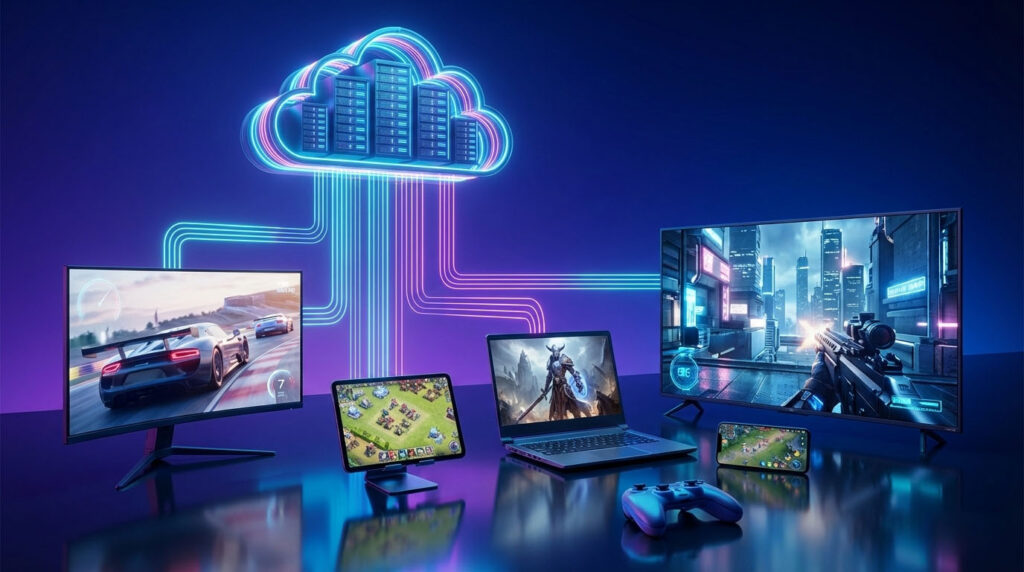
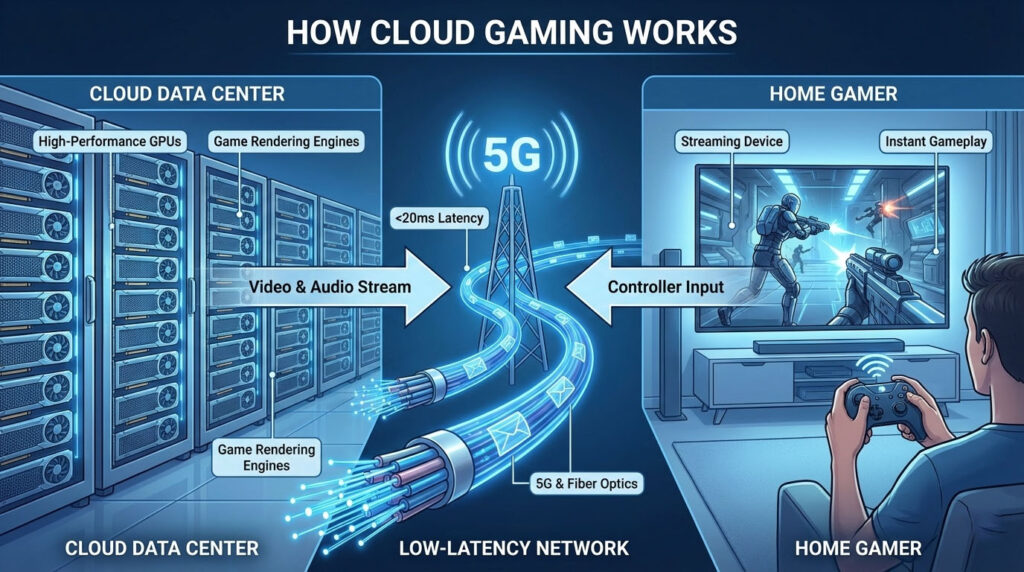
At its core, cloud gaming is a streaming service for video games.2 It functions similarly to Netflix or Spotify but with a critical difference: interactivity. When you stream a movie, the data flows one way (server to user). When you stream a game, the data must flow two ways instantly. You press a button on your controller, that signal travels to a server, the server processes the action (e.g., your character jumps), renders the new video frame, and sends it back to your screen.
History & Evolution
The concept isn’t entirely new. It began with ambitious but flawed pioneers like OnLive and Gaikai in the early 2010s. These services failed largely due to the infrastructure of the time; internet speeds were too slow, and latency (lag) was too high.
Fast forward to 2025, and the landscape has transformed. Sony acquired Gaikai to build PlayStation Cloud streaming. Microsoft leveraged its Azure infrastructure for Xbox Cloud Gaming. NVIDIA utilized its GPU dominance to build GeForce NOW.3 The failure of Google Stadia in 2023 served as a crucial lesson for the industry: technology alone isn’t enough; you need a sustainable business model and a library of games people actually want to play.
Difference Between Traditional and Cloud Gaming
| Feature | Traditional Gaming (Console/PC) | Cloud Gaming |
| Hardware | Requires expensive local hardware (GPU, CPU). | Runs on almost any device with a screen. |
| Game Access | Requires downloading/installing (100GB+). | Instant play; no downloads required. |
| Cost | High upfront cost ($500–$2,000). | Low monthly subscription ($10–$20). |
| Performance | Fixed by your hardware specs. | Upgradable server-side (e.g., RTX 4080 rigs). |
How Cloud Gaming Works
The “magic” of cloud gaming relies on a complex chain of technology that must execute in milliseconds to prevent input lag.
Servers and Data Centers
When you launch a game on a cloud platform, you are essentially renting a powerful virtual computer in a data center. These data centers are equipped with server-grade hardware. For instance, NVIDIA’s SuperPODs use thousands of GPUs to render millions of frames per second for users worldwide.
Streaming Technology
The video output from the game is compressed in real-time using advanced codecs (like H.265 or AV1).4 This compression reduces the bandwidth needed to send the image to your device without sacrificing visual quality.
The Role of Latency
Latency is the time it takes for data to travel from your device to the server and back.5 In 2025, Edge Computing has become a game-changer. By placing smaller server “nodes” physically closer to players (in major cities rather than just remote rural data centers), providers have cut latency down to sub-30ms levels, which is imperceptible to most casual gamers.6
Network Slicing for XR and Gaming
This document comprehensively explores research directions and technical specifications for next-generation wireless communication networks, including 5G, 6G and beyond, with a strong focus on cloud gaming and extended reality (XR) applications. It investigates how to optimise network performance, resource allocation, and quality of experience (QoE) for these demanding services, encompassing efficient network slicing, multi-connectivity, edge computing, and exploration of future wireless technologies.
Popular Cloud Gaming Platforms
The “Console Wars” have evolved into the “Cloud Wars.” Here are the dominant platforms in 2025.
NVIDIA GeForce NOW
GeForce NOW is widely considered the technical gold standard. It doesn’t sell you games; it connects to digital stores (Steam, Epic Games, Ubisoft) where you already own games and lets you play them on NVIDIA’s powerful servers.7
- Best For: PC gamers who want max graphics (4K, 120 FPS).8
- Key Feature: The “Ultimate” tier gives you access to RTX 4080-class performance.9
Xbox Cloud Gaming (xCloud)
Included with the Game Pass Ultimate subscription, this service focuses on value.10 It allows you to play hundreds of Xbox titles on your phone, tablet, or PC.
- Best For: Console gamers and value seekers.
- Key Feature: “Day One” releases—play new Microsoft games the moment they launch without buying them.11
PlayStation Cloud Gaming
Sony has integrated cloud streaming into its PlayStation Plus Premium tier.12 It allows PS5 owners to stream games directly to their console (saving storage space) and PC users to access a library of PlayStation classics.
- Best For: PlayStation loyalists.
Amazon Luna
Amazon’s entry leverages its massive AWS (Amazon Web Services) infrastructure and Twitch integration.13 You can watch a streamer on Twitch and instantly jump into the same game with the “Play on Luna” button.14
- Best For: Casual gamers and Prime members.
Google Stadia (A Retrospective)
While Stadia shut down in 2023, its technology lives on. Google now licenses the underlying streaming tech to other companies. The lesson from Stadia was clear: gamers prefer subscription libraries (like Netflix) or bringing their own games (like GeForce NOW) over buying full-priced games locked to a streaming-only platform.
Advantages of Cloud Gaming
No Expensive Hardware
This is the most significant barrier to entry that cloud gaming removes. You no longer need to scrape together $500 for a PS5 or $1,500 for a gaming PC. A $50 streaming stick or an old laptop works perfectly.
Play Anywhere, Anytime
Cloud gaming decouples the gaming experience from the living room. You can start a game on your TV, continue it on your phone during your commute (via 5G), and finish it on your laptop in bed. This “screen agnosticism” is the ultimate convenience.
Instant Access (No Downloads)
Modern games like Call of Duty can exceed 200GB. On a standard internet connection, that’s hours of waiting. Cloud gaming eliminates this entirely. You click “Play,” and the game launches in seconds.
Cross-Platform Capabilities
Cloud gaming inherently supports cross-platform play.15 Since the hardware is virtualized, developers can more easily enable multiplayer between friends on different physical devices.
Disadvantages & Challenges
Internet Dependency
If your internet goes down, your gaming console becomes a paperweight. Unlike a physical disc or installed game, you have zero access without a connection.
Latency and Input Lag
While technology has improved, the speed of light is a physical limit. Competitive esports players (who need millisecond precision) still prefer local hardware.16 For fast-paced shooters, even a tiny delay can be frustrating for professional gamers.
Data Consumption
Streaming video games eats data voraciously.
- 1080p Streaming: ~3GB per hour.
- 4K Streaming: ~10GB+ per hour.If you have a data cap on your home internet or mobile plan, cloud gaming can exhaust it quickly.
Cloud Gaming vs Traditional Gaming
| Feature | Cloud Gaming | Traditional Console/PC |
| Ownership | You often subscribe to access; if the service dies, you may lose saves/access. | You own the disc or digital file locally. |
| Visual Fidelity | Compressed video stream (occasional artifacts). | Uncompressed, raw visual output. |
| Input Lag | Variable (30ms – 100ms). | Near zero (<10ms). |
| Upgrades | Automatic server-side upgrades. | You must buy new consoles/parts every 5-7 years. |
| Convenience | Instant, no installs. | Requires storage management and updates. |
Internet Requirements for Cloud Gaming
In 2025, “fast” isn’t the only requirement; “stable” is better.
Minimum & Recommended Speeds
- 720p Mobile Gaming: Minimum 15 Mbps.
- 1080p/60FPS (Standard): Recommended 25 Mbps.17
- 4K/120FPS (Pro): Recommended 45–50 Mbps.18
The Impact of 5G and Fiber
Fiber optic internet is the gold standard for cloud gaming because it offers symmetrical speeds and low ping.19 However, 5G has revolutionized mobile cloud gaming. With 5G Standalone (SA) networks rolling out globally, latency on mobile data has dropped significantly, making high-fidelity gaming on a bus or park bench a reality.20
Latency and Ping
Speed (Bandwidth) is how much data you can move. Latency (Ping) is how fast it travels. For cloud gaming:
- < 20ms: Excellent (Console feel).
- 20-50ms: Good (Playable for most games).
- > 60ms: Noticeable lag (Difficult for shooters).
Cloud Gaming for Mobile & Smart TVs
The Mobile Gaming Revolution
Smartphones are now powerful enough to decode high-quality video streams, meaning a $300 Android phone can play Assassin’s Creed with better graphics than a Nintendo Switch.21 Accessories like the Backbone One or Razer Kishi turn phones into ergonomic handheld consoles, driving massive adoption in Asia and mobile-first markets.
Smart TV Integration
Samsung and LG have aggressively integrated cloud gaming hubs directly into their TVs.22 In 2025, you can buy a Samsung TV, pair an Xbox controller via Bluetooth, and launch the Xbox app without ever owning a console box. This significantly lowers the barrier to entry for casual families.
Business & Industry Impact
Game Developers & Publishers
Developers are now creating “Cloud Native” games—titles designed specifically to run on servers, using physics and processing power that no single home console could achieve.
Subscription Economy
The industry is moving toward a “Netflix for Games” model. While this provides great value for consumers ($15/month for 500 games), some developers worry it devalues individual game sales.
Esports & Streaming
Cloud gaming is democratizing esports. A kid in a developing nation with a basic laptop can now compete in high-fidelity games that previously required a $2,000 PC, provided they have good internet.
Security, Privacy, and Data Protection in Cloud Gaming
One of the most overlooked aspects of cloud gaming is data security. Since gameplay happens on remote servers, user data—including login credentials, gameplay history, voice chats, and payment information—travels continuously between devices and cloud infrastructure.
Cloud Gaming and AI
Artificial Intelligence is the secret weapon for cloud gaming in 2025.23
AI-Powered Upscaling
NVIDIA uses DLSS (Deep Learning Super Sampling) in the cloud.24 The server renders the game at a lower resolution (saving bandwidth) and uses AI to upscale it to 4K on your device.25 This looks sharp but requires less internet speed.
Predictive Latency Optimization
New AI algorithms are being tested to “predict” your next button press. If the AI guesses you are about to jump, it can begin rendering that frame milliseconds before you actually press the button.26 If it guesses right, zero latency. If wrong, it corrects instantly.
Cloud Gaming Market Size & Future Growth
The statistics for 2025 are bullish:
- Market Value: Estimated at $15.74 Billion in 2025.27
- Growth Rate: Expected CAGR of over 33% – 45% through 2032.28
- Emerging Markets: Asia Pacific is the largest market, driven by mobile-first gamers in China, India, and South Korea who leapfrogged the console generation entirely.29
Is Cloud Gaming the Future?
Expert Opinions
Most tech analysts agree: Cloud gaming will not replace consoles overnight, but it will eventually make them niche. Just as vinyl records exist alongside Spotify, high-end consoles will exist for enthusiasts who demand zero compression and zero lag. For the other 90% of the world, the cloud will be “good enough” and far cheaper.
Consumer Adoption Trends
As of 2025, over 50% of gamers have tried a cloud service. The “hybrid” model is currently dominant: gamers own a console but use cloud streaming to try games before downloading them or to play when away from home.
Long-Term Sustainability
The environmental cost of data centers is a concern. However, centralized servers can be more energy-efficient than millions of individual consoles idling in homes, provided the data centers are powered by renewable energy.
Cloud Gaming Market Accelerates Toward 100 Billion Dollar Market Cap
Research firms project cloud gaming’s explosive trajectory into the 2030s. The global cloud gaming market reached $15.74 billion in 2025 and analysts forecast growth to $121.77 billion by 2032 according to Fortune Business Insights. This represents a compound annual growth rate exceeding 44% through the decade.
Cloud Gaming Accessibility & Inclusive Gaming
Because no expensive hardware is required, cloud gaming allows:
- Students
- Budget gamers
- Developing countries
to access AAA titles using affordable devices.
Accessibility Features
Cloud gaming platforms increasingly support:
- Custom controller mappings
- Voice commands
- AI-assisted gameplay
- Color-blind and motor-assist options
This opens gaming to players with physical disabilities.
Conclusion
Cloud gaming has graduated from a buggy experiment to a robust pillar of the gaming industry. In 2025, services like NVIDIA GeForce NOW and Xbox Cloud Gaming offer a compelling, cost-effective alternative to expensive hardware.30 While challenges regarding internet infrastructure and data caps remain, the trajectory is clear: the future of gaming is accessible, screen-agnostic, and increasingly streamed from the cloud.
For the hardcore gamer, your PC tower is safe—for now. But for the billions of potential gamers who just want to play without the hassle, the cloud isn’t just the future; it’s already here.
What Gamers Should Expect Next: Watch for the rollout of “Cloud-Native” games that do things impossible on local hardware, such as massive physics simulations and 1,000-player battles, later this year.

