
Table of Contents
Analyzing the reported $83B Netflix Warner Bros acquisition. We detail the strategic reasons, financial implications, antitrust risks, and how this Big Tech Acquisitions defines the future of the streaming industry changes.
Introduction – A Landmark Moment in Entertainment and Technology
The reported agreement for Netflix’s acquisition of Warner Bros. studio and streaming business marks a pivotal, high-stakes moment in the ongoing consolidation of the entertainment landscape. Valued at an astounding $82.7 billion, this deal is not merely a corporate transaction; it is a declaration of war—or perhaps, an armistice—in the cutthroat streaming wars.
This proposed Big Tech Acquisitions brings together two forces with complementary strengths: Netflix, the undisputed global pioneer of subscription video on demand (SVOD) with over 300 million global subscribers and cutting-edge data science; and Warner Bros. (WB), the century-old bastion of Hollywood’s most revered intellectual property (IP), including HBO, DC Comics, and the Harry Potter universe. The news instantly dominates global headlines because its successful completion would create an unmatched content behemoth, permanently altering the competitive balance and consumer choice in the video Big Tech Acquisitions streaming market, which is projected to exceed $800 billion globally by 2032.
Background – Netflix, Warner Bros., and the Evolution of the Streaming Era
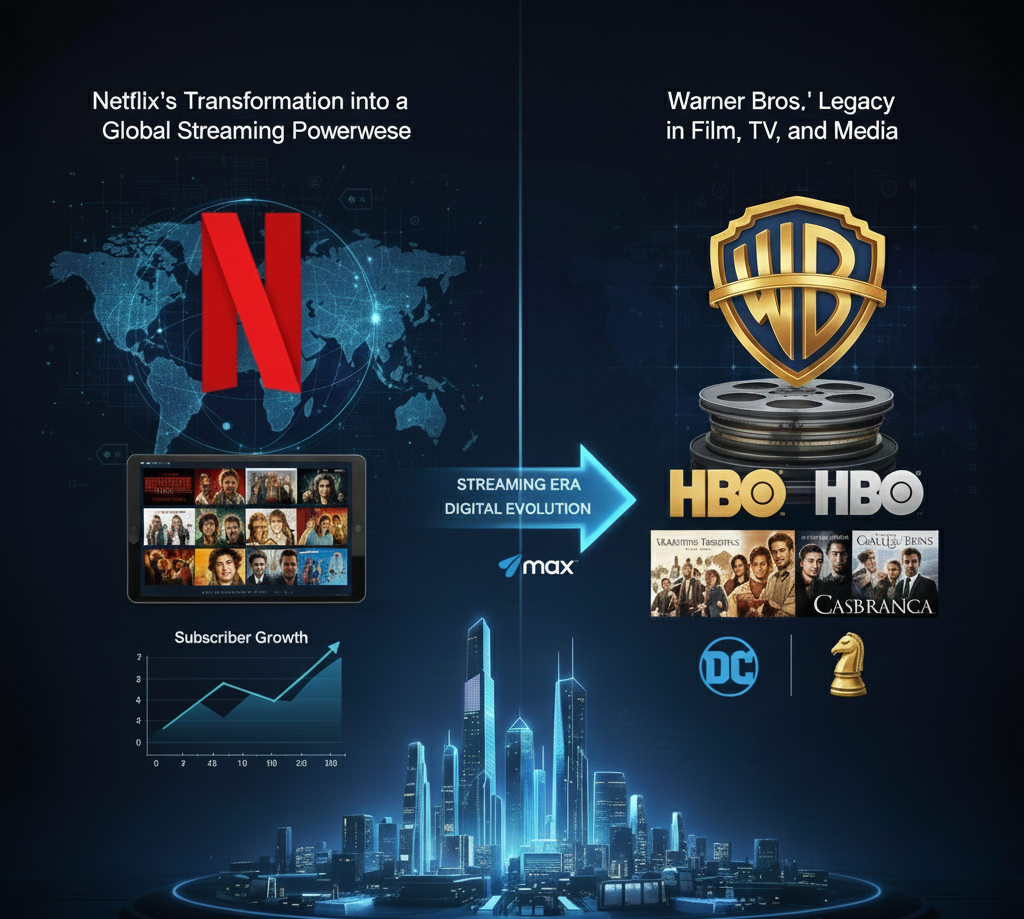
The stage for this historic deal was set by the relentless digital disruption of linear television and the subsequent scramble for scale in the 21st century.
Netflix’s Transformation Into a Global Streaming Powerhouse
Netflix began its journey in 1997 as a DVD rental service. Its true disruptive force, however, emerged with the launch of streaming in 2007, culminating in a radical pivot to content creation with House of Cards in 2013. This transformation established Netflix’s core philosophy: scale through originals and global reach.
As of 2025, Netflix reports over 300 million global paid subscribers and generated nearly $39 billion in annual revenue in the preceding year. Its success is built on two pillars: unparalleled global distribution and a data-driven model that informs every greenlight decision. However, the company has increasingly struggled with the rising cost of content—spending over $16 billion annually—much of which is on new, unproven original titles, leading to the necessity Big Tech Acquisitions of acquiring proven, durable library content.
The Legacy and Influence of Warner Bros. in Global Media
Warner Bros. stands as one of the original “Big Five” film studios, a powerhouse established in 1923. Its library is a treasure trove of cultural touchstones. In recent years, as part of the complexly structured Warner Bros. Discovery (WBD), the studio and its crown jewels—HBO and the Max streaming service—have sought stable corporate ownership to compete effectively with the likes of Disney and Amazon. WBD’s assets represent essential evergreen IP with multi-generational appeal.
Major Industry Mergers That Set the Stage
The reported Netflix Warner Bros acquisition is the latest, and potentially largest, in a decade-long cycle of bBig Tech Acquisitions mergers designed to achieve vertical integration and competitive scale.
- Disney/21st Century Fox ($71.3 Billion, 2019): This merger gave Disney control of Fox’s film and TV studios, The Simpsons, and crucial control over Hulu, directly bolstering Disney+’s launch.
- AT&T/Time Warner ($85 Billion, 2018): Although ultimately unwound and merged with Discovery (forming WBD), this deal showcased the desire of distributors to own content.
- Microsoft/Activision Blizzard ($69 Billion, 2023): Though in gaming, this deal demonstrated regulators’ increased tolerance for Big Tech acquiring massive content libraries (IP) for ecosystem dominance.
These deals confirm that in the streaming age, control over proprietary IP is the ultimate currency, making the WB library an indispensable target.
Inside the Reported Acquisition Deal
The complexity and sheer financial size of the proposed transaction make it a landmark event on Wall Street.
Estimated Value and Financial Breakdown
The deal, as reported, involves a massive outlay and specific structural demands:
| Metric | Estimated Value / Detail | Significance |
| Total Enterprise Value | $\approx \$82.7$ Billion | Reflects the high premium paid for proven IP and immediate scale. |
| Equity Value | $\approx \$72.0$ Billion | The value of the shares being acquired by Netflix. |
| WBD Share Price | $\$27.75$ per share (Cash & Stock) | A substantial premium over WBD’s pre-report trading price, highlighting Netflix’s aggressive bid. |
| Breakup Fee | $\approx \$5.8$ Billion | A record-high termination fee signaling Netflix’s commitment to fighting regulatory hurdles. |
The transaction is structured as a complex cash-and-stock merger, crucially following the spin-off of the highly-leveraged WBD’s Global Networks (cable) division, ensuring Netflix acquires a leaner, pure-play content engine.
What Assets Are Included in the Warner Bros. Package
Netflix is specifically targeting the core creative and distribution assets:
- Warner Bros. Film and Television Studios: The physical production infrastructure and thousands of hours of content creation.
- The Content Library and IP: This includes the entire DC Comics universe, the Wizarding World (Harry Potter), Lord of the Rings, the classic MGM library titles, and Warner Bros. Television hits like Friends and The Big Bang Theory.
- HBO and Max: The prestigious premium television brand and its entire back catalog (The Sopranos, Succession, Game of Thrones) plus the Max streaming platform’s current global subscriber base.
The exclusion of WBD’s linear cable networks (e.g., Discovery Channel, TLC) and, most notably, CNN, simplifies the regulatory path by avoiding the combination of a distribution platform with major news media.
Why This Deal Matters for Big Tech Expansion
This acquisition represents the ultimate vertical integration for a Big Tech streaming company. Netflix, which has always been a content distributor using originals to attract subscribers, becomes a bona fide studio owner. This puts them on an equal competitive footing with Disney, which has always controlled its own production destiny.
By purchasing WB, Netflix transitions from renting IP to owning, controlling, and exploiting IP across all global windows, a model highly valued by Amazon (which owns MGM) and Apple.
Why Netflix Wants Warner Bros.
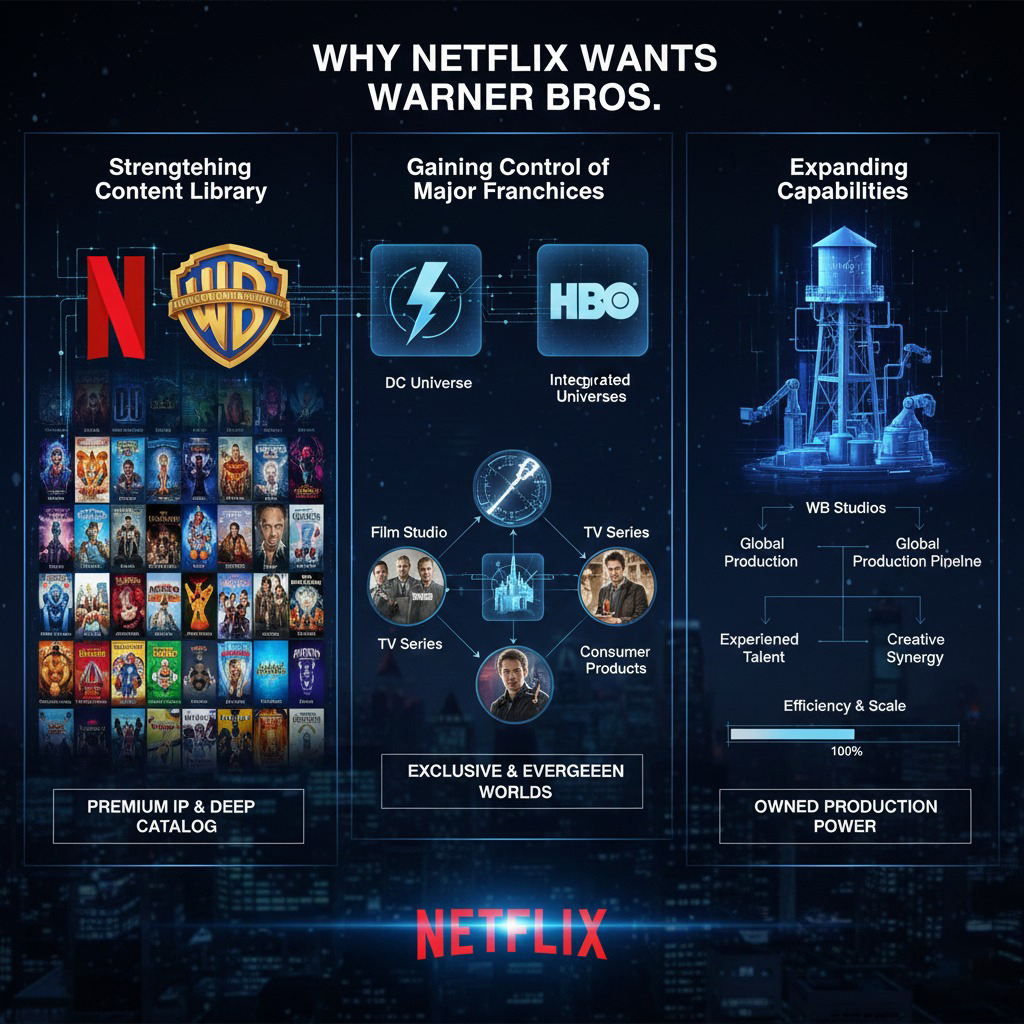
The strategic rationale for the Big Tech Acquisitions Netflix content library expansion is twofold: defensiveness against rising content costs and an aggressive push for global dominance.
Strengthening Content Library With Premium IP
The single biggest drain on Netflix’s profitability has been the escalating cost of producing original content, estimated to be over $16 billion in 2024. While originals attract new subscribers, it is the library content that keeps them. Netflix’s current library size is significantly smaller than competitors like Amazon Prime Video, which has over 20,000 movies.
Acquiring the WB library instantly adds thousands of hours of high-quality, critically acclaimed content (e.g., HBO shows), dramatically increasing the retention value for existing members and providing a powerful incentive for new subscribers to join.
Gaining Control of Major Franchises and Universes
The most valuable assets are the global, perennial franchises that generate massive revenue across films, TV, and merchandise:
| Warner Bros. Franchise | Strategic Value to Netflix |
| DC Universe | Direct counter-programing to Disney’s dominant Marvel Cinematic Universe (MCU). |
| Wizarding World | A multi-billion dollar IP that guarantees subscriber churn reduction. |
| HBO/Prestige TV | Instant credibility and dominance in the high-end, awards-focused drama space. |
Control over these major IPs allows Netflix to launch interconnected universes (e.g., a Game of Thrones cinematic universe) exclusively on its platform, maximizing subscriber lock-in and merchandising profits.
Expanding Production Capabilities Through WB Studios
Owning the WB studios provides immediate access to world-class physical and human production infrastructure. Netflix has had to build its studios from scratch; WB offers a century of expertise, proven executive teams, sound stages, and backlots. This merger combines Netflix’s algorithmic development model with Warner Bros.’ traditional creative process, theoretically creating a faster, more efficient content pipeline.
Impact on the Global Streaming Landscape
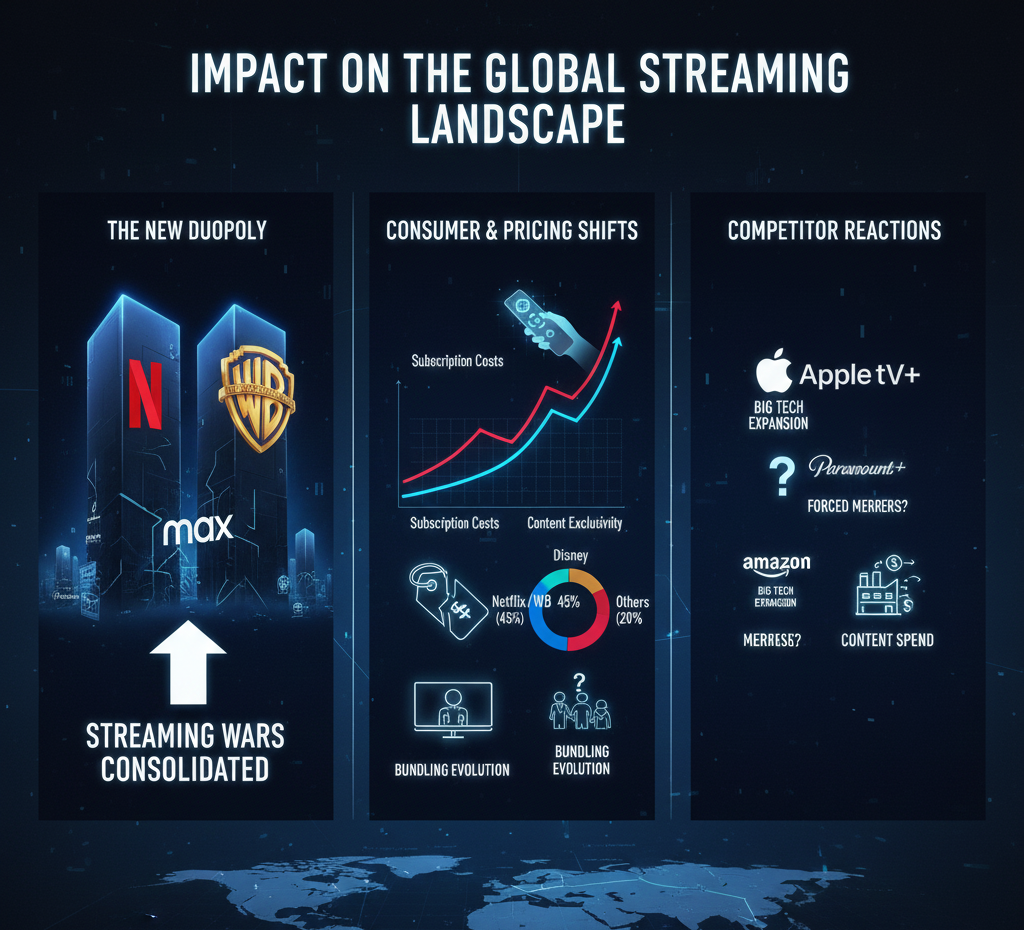
The deal is a market-defining event that will fundamentally change the competitive dynamic of the streaming industry changes.
Could This Mark the End of the Streaming Wars?
The acquisition will not end the streaming wars outright, but it will significantly narrow the field, transforming the contest from a multi-party free-for-all into an oligopoly defined by two major power blocks.
- The Two Titans: Netflix/Warner Bros. will battle directly with Disney/Hulu/ESPN+ for global subscription dominance. These two entities will control a disproportionately large share of global premium content and subscriber count.
- The Great Squeeze: Smaller, Big Tech Acquisitions less-scaled competitors like Paramount+ and Peacock will find it increasingly difficult to compete on content budget or IP depth, Big Tech Acquisitions making them prime targets for future consolidation by other cash-rich entities.
Expected Reactions From Competitors Like Disney, Amazon, and Apple
The response from rivals will be immediate and defensive:
- Disney: Will likely accelerate its full integration of Hulu and continue aggressive expansion of its MCU and Star Wars properties to counter Netflix’s new DC and Harry Potter arsenal.
- Amazon (Prime Video): Will leverage its massive retail ecosystem and look for new, complementary media acquisitions to secure more unique IP and build a counter-platform for premium sports or gaming content. Amazon’s acquisition of MGM already demonstrated this hunger for IP.
- Apple (Apple TV+): Possessing trillions in market value, Apple could be forced to increase its current content budget tenfold or look for its own massive, defensive studio acquisition to compete with the sheer volume of the new Netflix/WB library.
What It Means for Subscribers and Pricing
Historically, media mergers have led to consolidation of power, often resulting in increased prices for consumers.
- Price Hikes are Likely: With one major competitor (Max) absorbed, the combined entity will have fewer incentives to maintain low prices. Analysts expect the combined service’s cost to rise, leveraging the new exclusive content. Data shows that 74% of US households subscribe to at least one SVOD, Big Tech Acquisitions but many are willing to cut services if prices increase.
- Reduced Choice of Services: While Netflix’s content library expands, the overall number of major streaming competitors shrinks. The ability to “churn” between services to follow a few key shows is reduced when major franchises like HBO’s are locked into one super-platform.
- Ad-Tier Dominance: Big Tech Acquisitions The merger instantly creates a colossal ad-supported tier. The combination of Max’s premium adult content viewers with Netflix’s 94 million monthly active users on its ad-supported plan will create an undeniable force in the Ad-supported Video On Demand (AVOD) market Big Tech Acquisitions.
Financial, Strategic, and Business Implications
The core promise of the deal lies in the economic synergies derived from combining two large, often redundant, operations.
How the Deal Reshapes Netflix’s Revenue Model
The deal fundamentally shifts Netflix from a high-spending, debt-fueled content renter to a cash-flow-positive content owner.
- Content Cost Reduction: Netflix saves billions by eliminating the licensing fees it currently pays for WB/Max content and by reducing the enormous spend on speculative originals, as it now has a proven content pipeline.
- ARPU (Average Revenue Per User) Boost: Max subscribers generally have a higher ARPU due to the nature of HBO’s premium pricing. Migrating these high-value customers, alongside the new ad-tier scale, will immediately boost Netflix’s overall profitability metrics.
- Stabilization: Ownership of IP provides long-term financial stability, Big Tech Acquisitions cushioning the service from the volatility of single-hit show performance.
Effects on Warner Bros. Workforce and Business Structure
Merger integration will inevitably lead to significant organizational changes and redundancy:
- Job Cuts: Thousands of duplicate roles across Max’s technology/engineering, marketing, finance, and corporate divisions will be eliminated as Netflix consolidates these functions. The Writers Guild of America (WGA) and other creative unions have already voiced concerns about the negative impact on the workforce and wages.
- Cultural Clash: The creative, prestige-focused culture of HBO and the traditional Warner Bros. studio will be integrated into Netflix’s data-driven, technology-centric environment. Managing this cultural transition is one of the most critical execution risks.
New Monetization Possibilities for Netflix
Controlling the WB assets unlocks diverse new revenue streams that Netflix has traditionally ignored:
- Consumer Products and Licensing: Netflix gains access to the multi-billion dollar merchandising rights for Harry Potter, DC, and Looney Tunes, a segment where Disney excels and Netflix has been weak.
- Theatrical Window Optimization: Netflix now owns a premier theatrical distribution infrastructure. It can adopt a hybrid approach: massive theatrical releases for tentpole films (e.g., The Batman 2), followed by extremely short windows before the films hit the exclusive streaming service.
- Gaming and Interactive: The WB gaming division, which includes major titles, can be leveraged to expand Big Tech Acquisitions burgeoning video game segment, creating a truly cross-platform entertainment ecosystem.
Risks, Challenges, and Regulatory Barriers
Despite the strategic benefits, the deal faces enormous political, legal, and operational hurdles Big Tech Acquisitions that could derail the entire transaction.
US Antitrust Concerns and Government Scrutiny
This is the biggest threat. Given the size and impact, the deal is expected to trigger a full-scale antitrust review by the US Department of Justice (DOJ).
- Anticompetitive Presumption: Antitrust experts argue the merger would trigger a “structural presumption of anticompetitive effects” due to the sheer market concentration. One major Senator has already argued the deal would “create one massive media giant with control of close to half of the streaming market.”
- Vertical Integration Fears: Regulators fear that by owning both the key distribution platform (Netflix) Big Tech Acquisitions and essential content (WB), the combined company could refuse to license premium content to smaller rivals, thereby excluding them from the market. This fear was a core reason the DOJ challenged the AT&T/Time Warner merger.
- Political Climate: The current regulatory environment is highly skeptical of mega-mergers, Big Tech Acquisitions especially in the Big Tech sector, meaning the DOJ is expected to push for significant structural remedies or block the deal entirely.
Creative, Cultural, and Production Challenges
Integrating two wildly different creative cultures will be a titanic challenge.
- Dilution of Quality: There is a fear among critics and creatives that the high-volume, global-appeal mandates of Netflix could dilute the quality and prestige of the HBO brand, a Big Tech Acquisitions company renowned for prioritizing creative freedom over mass-market data.
- Talent Migration: Key creative talent associated with Warner Bros. and HBO may choose to leave rather than operate under a corporate structure they view as overly centralized or algorithmic, potentially devaluing the very assets Netflix is acquiring.
Licensing, Global Rights, and International Limitations
The global nature of the deal complicates its finalization:
- International Antitrust: The acquisition requires approval from regulatory bodies in the European Union, the UK, and other major global markets, each of which has strict rules on market dominance and data concentration.
- Existing Licensing Deals: WB content is currently licensed globally to various third parties (e.g., regional broadcasters, other streamers). Unwinding or buying out these complex, long-term contracts will be an expensive and time-consuming legal battle.
Expert Opinions and Market Reactions
The initial market reaction was characterized by a surge in WBD stock (driven by the high offer price) and a slight dip in Netflix’s shares, reflecting the cautious assessment of the price, debt, and integration risk.
- Wall Street Analysts: Generally see the deal as a bold, necessary move to secure long-term content costs, but express deep concern over the regulatory risk. They highlight the synergy potential—estimated in the billions annually—but caution that an $83 billion price tag leaves little room for error.
- Entertainment Insiders: Many view the move as the inevitable conclusion of the streaming wars, where only the owners of legacy IP can survive. They point out that competitors, including Paramount Skydance, attempted to acquire WBD, confirming the asset’s value.
- Antitrust Lawyers: They believe the DOJ has a strong case to challenge, especially under the new, Big Tech Acquisitions stricter merger guidelines, noting that this is a direct vertical and horizontal threat to competition.
Future Predictions – What This Acquisition Could Lead To
The Future of Streaming Platforms
The future points to two models: the Super-Platform (Netflix/WB, Disney) offering an unparalleled selection of Big Tech Acquisitions mass-market and premium content, Big Tech Acquisitions and highly Niche Platforms (like Shudder for horror or Mubi for arthouse cinema). The middle-ground streaming services will likely struggle and be forced to consolidate or sell.
Integration of Warner Bros. Titles Into Netflix
If successful, the integration will be rapid and total. The Max platform will be shut down and its entire library, including all HBO originals, will be absorbed into the Netflix service. Big Tech Acquisitions We can expect an immediate deluge of new, exclusive content on Netflix, from deep-catalog classics to prestige TV, fueling its ad-supported tiers and driving subscriber retention.
Potential for More Big Tech Acquisitions
The reported Netflix Warner Bros acquisition sets a precedent. If approved, Big Tech Acquisitions it validates the strategy of Big Tech Acquisitions up old Hollywood. The next logical targets for Amazon, Apple, or Comcast will be:
- Paramount Global: With its large content library (CBS, Paramount Pictures) and established broadcast networks.
- Lionsgate: With its valuable studio assets and strong film pipeline.
The deal will trigger a final, high-stakes domino effect of media consolidation.
Conclusion
Netflix’s reported acquisition of Warner Bros. studio and its streaming assets for a staggering sum represents a defining chapter in the history of digital media. It is a strategically brilliant, albeit financially immense, move aimed at fortifying Netflix against rising competition and content costs by acquiring an unparalleled vault of globally recognized, durable intellectual property. The resulting entity would be a vertically integrated powerhouse that rivals Disney in scale and influence. However, the path to completion is a minefield of regulatory Big Tech Acquisitions resistance, primarily over antitrust concerns regarding market dominance and consumer choice.
FAQs
Is Netflix really buying Warner Bros.?
As of the date of this report, a definitive agreement has been announced for Netflix to acquire the film studio and streaming business (Max) of Warner Bros. Discovery (WBD) for an estimated $82.7 billion. The deal is pending several major steps, including the corporate spin-off of WBD’s cable networks and, most critically, approval from US and international antitrust regulators. It is a proposed acquisition, not a completed one.
How much could the acquisition cost Netflix?
The reported enterprise value of the acquisition is approximately $82.7 billion, with an equity value of roughly $72.0 billion. This massive cost is being covered by a combination of cash and Netflix stock, and includes the assumption of some debt related to the Warner Bros. assets. It is one of the most expensive media acquisitions in history.
How will this acquisition affect streaming prices for consumers?
It is widely predicted that the deal will lead to higher prices for subscribers. By absorbing Max and its premium content into Netflix, the combined company significantly reduces major competition, giving it greater pricing power. Consumers may be forced to pay a higher consolidated price for access to the merged, exclusive library of Netflix/HBO/DC content.
What happens to Warner Bros. content like the DC Universe and HBO shows?
If the deal is approved, all Warner Bros. content—including the entire DC Comics film universe, the Harry Potter franchise, and all original shows from HBO (Game of Thrones, The Last of Us, Succession)—will become exclusive to the consolidated Netflix platform. The Max streaming service will cease to exist as a standalone offering.
Will US regulators allow this Big Tech media merger?
The deal faces enormous regulatory resistance, particularly from the US Department of Justice (DOJ). Antitrust experts argue that combining Netflix’s distribution dominance with Warner Bros.’ core content creation assets creates a harmful “gatekeeper” that could stifle competition and raise consumer prices. The DOJ is expected to launch a rigorous, lengthy investigation that may require significant concessions or could result in the deal being blocked entirely.

