
Table of Contents
The AI Calculus: US Approves Nvidia H200 Chip Sales to China with a 25% Revenue Cut
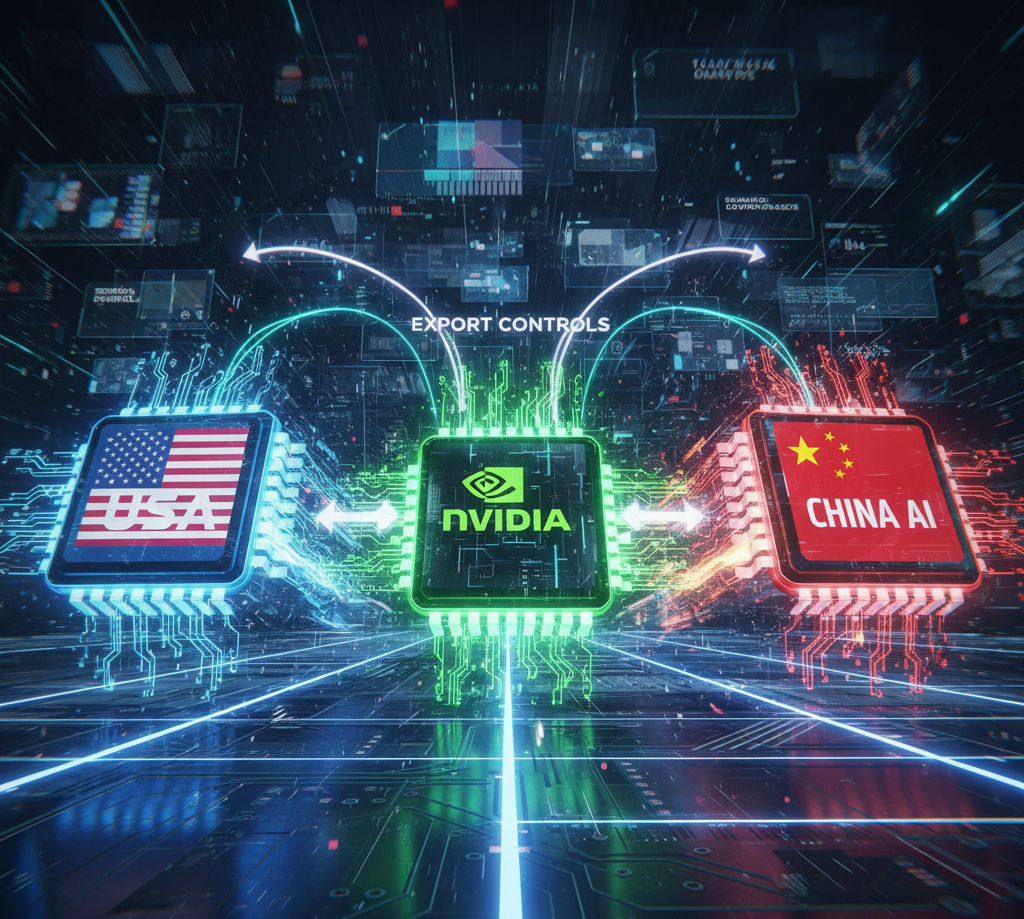
The landscape of global technological competition and trade war tensions shifted dramatically with the announcement that the U.S. administration has cleared the way for Nvidia to sell its powerful US Clears Nvidia H200 AI Chip to “approved customers” in China. This decision marks a significant policy reversal, moving away from the strict export controls previously implemented to curb China’s access to cutting-edge U.S. semiconductor technology. Crucially, the approval comes with an unprecedented stipulation: the U.S. government will receive a 25% cut of the sales revenue.
This development, finalized by the Commerce Department, impacts not onlyUS Clears Nvidia H200 AI Chipbut also the trajectory of China’s artificial intelligence development, global AI competition, and the legal framework of American export controls. It represents a complex geopolitical maneuver designed to balance national security interests with the economic imperative to maintain U.S. market dominance.
Understanding the H200 AI Chip and its Geopolitical Significance
The US Clears Nvidia H200 AI Chip approval is centered on a powerhouse piece of silicon, which is critical for training and deploying large language models (LLMs) and advanced generative AI applications.
H200 Specifications vs. Restricted Chips
The Nvidia H200 is an upgraded version of the “Hopper” generation architecture, succeeding the H100. The key differentiating factor is its use of HBM3e (High Bandwidth Memory 3e) technology.
| Feature | Nvidia H100 (Original) | Nvidia H200 (Approved for China) | Nvidia Blackwell (B200, Restricted) |
| Architecture | Hopper | Hopper | Blackwell (Next Gen) |
| Memory Capacity | 80 GB HBM3 | 141 GB HBM3e | Massive, Multi-Die |
| Memory Bandwidth | $\approx 3.35 \text{ TB/s}$ | $\approx 4.8 \text{ TB/s}$ | Significantly Higher |
| Power Level | High (Restricted) | High (Now Approved) | Highest (Strictly Restricted) |
| Primary Use | LLM Training, HPC | Large LLM Inference/Training | Next-Gen Trillion-Parameter Models |
The H200 is dramatically more capable than the previously China-specific, modified chips (like the H20), which were designed to fall below U.S. control thresholds. Estimates suggest the H200 is nearly six times as powerful as the H20.
The Policy Shift: Why the H200?
The U.S. administration’s approval is framed as a strategic balance—a middle ground between a full ban (which risks ceding the entire AI chip market China to domestic players) and unrestricted access (which poses national security risks).
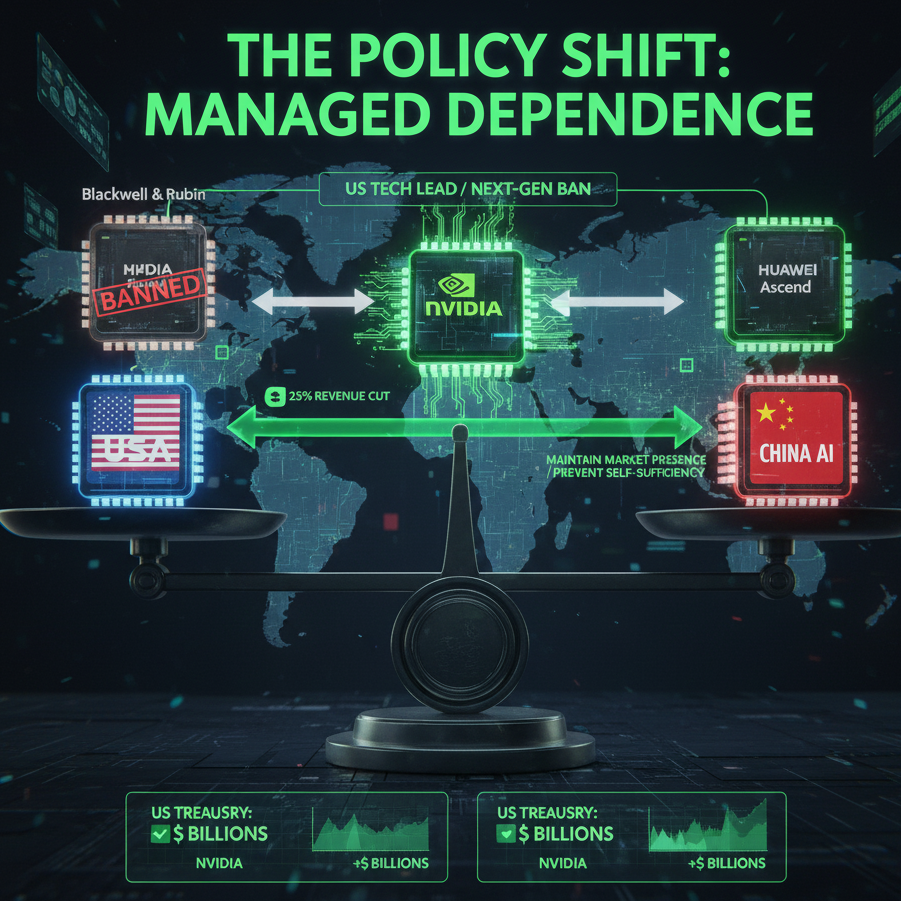
Keeping the Lead: Critically, the U.S. is maintaining the ban on the latest Blackwell generation and the upcoming Rubin chips, ensuring China remains at least one generation behind U.S. and allied militaries in foundational AI compute power.
Financial Incentive: The 25% revenue cut creates a direct financial benefit for the U.S. government and, by extension, the taxpayer.
Preventing Self-Sufficiency: By allowing the H200, the U.S. keeps China’s biggest tech firms partially reliant on U.S. technology standards, slowing down China’s domestic efforts to replace Nvidia with US Clears Nvidia H200 AI Chip local alternatives like Huawei’s Ascend chips.
Maintain Market Presence: Nvidia argued that a complete blackout would merely lead Chinese customers to flock to domestic rivals, eroding Nvidia’s market share and future revenue stream. The H200 allows Nvidia to recoup billions in lost revenue
Keeping the Lead: Critically, the U.S. is US Clears Nvidia H200 AI Chip maintaining the ban on the latest Blackwell generation and the upcoming Rubin chips, ensuring China remains at least one generation behind U.S. and allied militaries in foundational AI compute power.
The Unprecedented 25% Revenue Cut: Economic and Legal Implications
The most unique and controversial aspect of this policy is the mandated 25% cut of sales revenue, which the U.S. government will collect.
What the 25% Revenue Cut Means
This fee, which is reportedly collected as an import tax when the chips travel from the manufacturing hub (Taiwan) to the U.S. for security vetting before onward export to China, serves multiple functions:
Mitigation of Risk: The levy is arguably intended to offset the perceived national security risk by making the U.S. a financial beneficiary of the sales.
Direct Treasury Benefit: It creates a direct, substantial funding source for the U.S. government, potentially generating billions of dollars annually given the high price and demand for these chips.
Political Framing: It allows the administration to frame the policy as a “win for America,” securing both jobs for the American company (Nvidia) and revenue for the U.S. Treasury.
Legal and Constitutional Questions
This arrangement has drawn criticism from legal and trade experts, raising questions about its compliance with constitutional principles:
- Export Tax Prohibition: The U.S. Constitution prohibits taxes or duties on exports. The structure of the fee—collected as an import tax upon entry to the U.S. for vetting—attempts to circumvent this, though its nature as a condition of an export license is still highly unusual.
- Precedent for Private Industry: Setting a precedent for the government to take a direct financial stake in the revenue of a private company’s foreign sales is seen by many as an unprecedented intrusion into free-market operations.
Business Impact and Nvidia’s Strategic Positioning
For Nvidia, this policy reversal is a massive financial boon, albeit one that comes with new, complicated regulatory constraints.
Nvidia’s Revenue and Stock Impact
- Recouping Losses: Following earlier, stricter restrictions, Nvidia had seen its China revenue collapse, going from an estimated 90%+ market share to nearly zero in the high-end segment. The H200 approval re-opens a multi-billion-dollar market.
- Stock Market Reaction: The news led to a notable jump in Nvidia’s share price, reflecting investor optimism about the return of a lucrative revenue stream.
- Nvidia’s Strategy: CEO Jensen Huang has consistently argued for a balanced approach, stating that continuous U.S. market presence, even with slightly older chips, is preferable to ceding the massive Chinese market to rivals. The company framed the H200 offering as a “thoughtful balance that is great for America,” supporting U.S. jobs and manufacturing.
Export-Control Rules and Vetting Process
The chips will be sold only to “approved commercial customers” vetted by the Commerce Department. This vetting process is crucial for national security, ensuring the chips do not end up in the hands of entities on restricted lists, such as those associated with the Chinese military or surveillance state. This introduces significant administrative overhead and risk for Nvidia regarding compliance.
Impact on China’s AI Development and Global Competition
The approval of US Clears Nvidia H200 AI Chip fundamentally changes the dynamics of the US Clears Nvidia H200 AI Chip and the global race for AI dominance.
China’s AI Development Boost
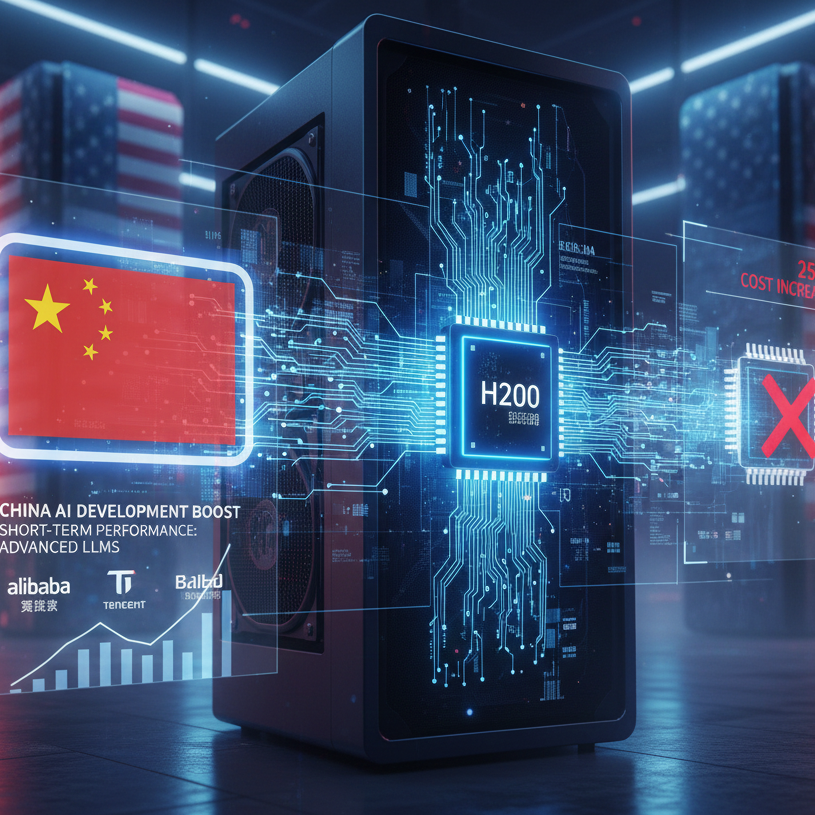
- Short-Term Performance: Access to the H200—which is significantly more powerful than domestic alternatives and previously approved restricted chips US Clears Nvidia H200 AI Chip will provide an immediate, major boost to Chinese tech giants like Alibaba, Tencent, and Baidu. It will allow them to train and deploy more advanced large language models more quickly.
- Bridging the Gap: While the US Clears Nvidia H200 AI Chipis not the latest U.S. technology, it allows Chinese AI labs to build supercomputers capable of performance levels similar to top US Clears Nvidia H200 AI Chip U.S. AI supercomputers, albeit at a higher cost due to the 25% fee. This helps China close the compute gap on foundational models.
Impact on Global AI Competition
The U.S. advantage in the AI race relies on its lead in cutting-edge chip technology.
- Maintaining a Generational Gap: The core strategy remains to ensure that the Chinese military and research labs cannot access the absolute cutting edge (Blackwell and Rubin). This two-tiered system attempts to maintain a technical “moat” around the most sensitive applications.
- Huawei’s Challenge: The move is a direct challenge to the growing market share of domestic Chinese rivals like Huawei, whose Ascend chips benefited greatly from the earlier U.S. bans. Reintroducing a powerful Nvidia product like the H200 places immediate pressure on Chinese firms to justify purchasing the more expensive, less-proven domestic chips.
Political and Industry Reactions
The policy shift has triggered varied and passionate responses across Washington D.C. and the U.S. tech sector.
Reactions from US Lawmakers
The decision has not been met with universal approval, particularly among national security hawks in both political parties.
- Criticism of National Security Risk: Democratic senators, including Elizabeth Warren and Andy Kim, voiced strong opposition, calling the move a “colossal economic and national security failure.” Their concern centers on the risk that the H200’s immense power could still be repurposed to advance China’s military modernization, surveillance, and cyber capabilities.
- Concerns over Precedent: The 25% revenue cut has been scrutinized for setting a potentially dangerous precedent for government intervention in private commerce.
Tech Industry Perspective
- Nvidia and Competitors: Nvidia welcomed the decision, citing the benefits to American jobs and manufacturing. The administration indicated that “the same approach” would be extended to other U.S. AI chip manufacturers, including AMD and Intel, potentially opening up a lucrative market for their comparable second-tier chips.
- The Smuggling Paradox: Coincidentally, the announcement came on the same day the U.S. Justice Department revealed charges against two businessmen for allegedly smuggling over $160 million worth of restricted Nvidia H100 and H200 chips to China. This underscores the intense demand and the difficulty of enforcing controls, which may have factored into the policy change.
Future Predictions and the AI Chip Landscape
The new export policy sets the stage for a period of managed competition in the US Clears Nvidia H200 AI Chip.
Future Trajectory and Next-Generation Controls
- Iterative Loopholes: Nvidia US Clears Nvidia H200 AI Chip and its rivals will continue to design “China-specific” US Clears Nvidia H200 AI Chip that push the regulatory limits just below the U.S. government’s defined performance thresholds (measured in TPP, or Total Processing Performance), leading to a constant cycle of new chips and new U.S. regulations.
- Increased Costs for China: The 25% surcharge significantly increases the cost of AI development for Chinese tech firms, acting as a soft constraint on their scale and budget.
- China’s Self-Reliance Drive: The policy, despite allowing some sales, reinforces China’s long-term strategic goal of semiconductor independence. Chinese policy and funding will continue to aggressively drive domestic innovation and talent acquisition to reduce reliance on U.S. technology. This temporary relief will likely accelerate China’s indigenous chip efforts over the long term.
Frequently Asked Questions (FAQs)
Q1: Why did the US administration approve the sale of the H200 chip?
A: The decision was a strategic reversal to balance national security with economic benefit. The H200 is an older generation than the flagship Blackwell, allowing the U.S. to maintain a technological lead while generating billions in revenue (via the 25% cut) and preventing U.S. companies from losing the entire Chinese market to domestic rivals like Huawei.
Q2: Is the H200 chip as powerful as Nvidia’s latest chips?
A: No. The H200 is Nvidia’s second-most powerful chip, part of the previous “Hopper” generation. The most advanced chips, the Blackwell series (B200) and the upcoming Rubin chips, remain strictly banned from export to China. The H200 is, however, significantly more powerful than any chip China can currently produce at scale.
Q3: What is the purpose of the 25% revenue cut?
A: The 25% cut is an unprecedented financial requirement imposed by the U.S. government on Nvidia China chip sales. Its primary purposes are to generate revenue for the U.S. Treasury and to frame the policy as a net economic win for the U.S.
Q4: How will this policy impact China’s domestic AI chip industry?
A: In the short term, it places significant competitive pressure on domestic Chinese chipmakers like Huawei, as Chinese tech giants can now purchase a superior, commercially proven chip. However, in the long term, the high cost (due to the 25% cut) and the enduring threat of future bans will only accelerate Beijing’s aggressive push for complete semiconductor self-reliance.
Q5: Does this policy change apply to other chipmakers?
A: Yes. The U.S. administration indicated that the “same approach” and framework, including the 25% revenue cut, would apply to other U.S. AI chip export firms, including Advanced Micro Devices (AMD) and Intel, for their comparable second-tier products.
SEO Title: US Clears Nvidia H200 AI Chip Sales to China: National Security, $Billions, and a 25% Revenue Cut – The New Era of AI Export Controls
Meta Description: The U.S. has approved Nvidia’s H200 AI chip exports to China, demanding a 25% revenue cut. Explore the political reversal, business impact, and the future of Nvidia China chip sales and US export controls Nvidia.
The AI Calculus: US Approves Nvidia H200 Chip Sales to China with a 25% Revenue Cut
The landscape of global technological competition and trade war tensions shifted dramatically with the announcement that the U.S. administration has cleared the way for Nvidia to sell its powerful H200 AI chips to “approved customers” in China. This decision marks a significant policy reversal, moving away from the strict export controls previously implemented to curb China’s access to cutting-edge U.S. semiconductor technology. Crucially, the approval comes with an unprecedented stipulation: the U.S. government will receive a 25% cut of the sales revenue.
This development, finalized by the Commerce Department, impacts not only US Clears Nvidia H200 AI Chip but also the trajectory of China’s artificial intelligence development, global AI competition, and the legal framework of American export controls. It represents a complex geopolitical maneuver designed to balance national security interests with the economic imperative to maintain U.S. market dominance.
Understanding the H200 AI Chip and its Geopolitical Significance
The US Clears Nvidia H200 AI Chip approval is centered on a powerhouse piece of silicon, which is critical for training and deploying large language models (LLMs) and advanced generative AI applications.
H200 Specifications vs. Restricted Chips
The Nvidia H200 is an upgraded version of the “Hopper” generation architecture, succeeding the H100. The key differentiating factor is its use of HBM3e (High Bandwidth Memory 3e) technology.
| Feature | Nvidia H100 (Original) | Nvidia H200 (Approved for China) | Nvidia Blackwell (B200, Restricted) |
| Architecture | Hopper | Hopper | Blackwell (Next Gen) |
| Memory Capacity | 80 GB HBM3 | 141 GB HBM3e | Massive, Multi-Die |
| Memory Bandwidth | $\approx 3.35 \text{ TB/s}$ | $\approx 4.8 \text{ TB/s}$ | Significantly Higher |
| Power Level | High (Restricted) | High (Now Approved) | Highest (Strictly Restricted) |
| Primary Use | LLM Training, HPC | Large LLM Inference/Training | Next-Gen Trillion-Parameter Models |
The H200 is dramatically more capable than the previously China-specific, modified chips (like the H20), which were designed to fall below U.S. control thresholds. Estimates suggest the H200 is nearly six times as powerful as the H20.
The Policy Shift: Why the H200?
The U.S. administration’s approval is framed as a strategic balance—a middle ground between a full ban (which risks ceding the entire US Clears Nvidia H200 AI Chip to domestic players) and unrestricted access (which poses national security risks).
- Financial Incentive: The 25% revenue cut creates a direct financial benefit for the U.S. government and, by extension, the taxpayer.
- Preventing Self-Sufficiency: By allowing the H200, the U.S. keeps China’s biggest tech firms partially reliant on U.S. technology standards, slowing down China’s domestic efforts to replace Nvidia with local alternatives like Huawei’s Ascend chips.
- Maintain Market Presence: Nvidia argued that a complete blackout would merely lead Chinese customers to flock to domestic rivals, eroding Nvidia’s market share and future revenue stream. The H200 allows Nvidia to recoup billions in lost revenue.
- Keeping the Lead: Critically, the U.S. is maintaining the ban on the latest US Clears Nvidia H200 AI Chip generation and the upcoming Rubin chips, ensuring China remains at least one generation behind U.S. and allied militaries in foundational AI compute power.
The Unprecedented 25% Revenue Cut: Economic and Legal Implications
The most unique and controversial aspect of this policy is the mandated 25% cut of sales revenue, which the U.S. government will collect.
What the 25% Revenue Cut Means
This fee, which is reportedly collected as an import tax when the chips travel from the manufacturing hub (Taiwan) to the U.S. for security vetting before onward export to China,US Clears Nvidia H200 AI Chip serves multiple functions:
- Direct Treasury Benefit: It creates a direct, substantial funding source for the U.S. government, potentially generating billions of dollars annually given the high price and demand for these chips.
- Political Framing: It allows the administration to frame the policy as a “win for America,” securing both jobs for the American company (Nvidia) and revenue for the U.S. Treasury.
- Mitigation of Risk: The levy is arguably intended to offset the perceived national security risk by making the U.S. a financial beneficiary of the sales.
Legal and Constitutional Questions
This arrangement has drawn criticism from legal and trade experts, raising questions about its compliance with constitutional principles:
- Export Tax Prohibition: The U.S. Constitution prohibits taxes or duties on exports. The structure of the fee—collected as an import tax upon entry to the U.S. for vetting—attempts to circumvent this, though its nature as a condition of an export license is still highly unusual.
- Precedent for Private Industry: Setting a precedent for the government to take a direct financial stake in the revenue of a private company’s foreign sales is seen by many as an unprecedented intrusion into free-market operations.
Business Impact and Nvidia’s Strategic Positioning
For Nvidia, this policy reversal is a massive financial boon, albeit one that comes with new, complicated regulatory constraints.
Nvidia’s Revenue and Stock Impact
- Recouping Losses: Following earlier, stricter restrictions, Nvidia had seen its China revenue collapse, going from an estimated 90%+ market share to nearly zero in the high-end segment. The H200 approval re-opens a multi-billion-dollar market.
- Stock Market Reaction: The news led to a notable jump in Nvidia’s share price, reflecting investor optimism about the return of a lucrative revenue stream.
- Nvidia’s Strategy: CEO Jensen Huang has consistently argued for a balanced approach, stating that continuous U.S. market presence, even with slightly older chips, is preferable to ceding the massive Chinese market to rivals. The company framed the H200 offering as a “thoughtful balance that is great for America,” supporting U.S. jobs and manufacturing.
Export-Control Rules and Vetting Process
The chips will be sold only to “approved commercial customers” vetted by the Commerce Department. This vetting process is crucial for national security, ensuring the chips do not end up in the hands of entities on restricted lists, such as those associated with the Chinese military or surveillance state. This introduces significant administrative overhead and risk for Nvidia regarding compliance.
Impact on China’s AI Development and Global Competition
The approval fundamentally changes the dynamics of the AI chip market China and the global race for AI dominance.
China’s AI Development Boost
- Short-Term Performance: Access to the H200—which is significantly more powerful than domestic alternatives and previously approved restricted chips—will provide an immediate, major boost to Chinese tech giants like Alibaba, Tencent, and Baidu. It will allow them to train and deploy more advanced large language models more quickly.
- Bridging the Gap: While the H200 is not the latest U.S. technology, it allows Chinese AI labs to build supercomputers capable of performance levels similar to top U.S. AI supercomputers, albeit at a higher cost due to the 25% fee. This helps China close the compute gap on foundational models.
Impact on Global AI Competition
The U.S. advantage in the AI race relies on its lead in cutting-edge chip technology.
- Maintaining a Generational Gap: The core strategy remains to ensure that the Chinese military and research labs cannot access the absolute cutting edge (Blackwell and Rubin). This two-tiered system attempts to maintain a technical “moat” around the most sensitive applications.
- Huawei’s Challenge: The move is a direct challenge to the growing market share of domestic Chinese rivals like Huawei, whose Ascend chips benefited greatly from the earlier U.S. bans. Reintroducing a powerful Nvidia product like the H200 places immediate pressure on Chinese firms to justify purchasing the more expensive, less-proven domestic chips.
Political and Industry Reactions
The policy shift has triggered varied and passionate responses across Washington D.C. and the U.S. tech sector.
Reactions from US Lawmakers
The decision has not been met with universal approval, particularly among national security hawks in both political parties.
- Criticism of National Security Risk: Democratic senators, including Elizabeth Warren and Andy Kim, voiced strong opposition, calling the move a “colossal economic and national security failure.” Their concern centers on the risk that the H200’s immense power could still be repurposed to advance China’s military modernization, surveillance, and cyber capabilities.
- Concerns over Precedent: The 25% revenue cut has been scrutinized for setting a potentially dangerous precedent for government intervention in private commerce.
Tech Industry Perspective
- Nvidia and Competitors: Nvidia welcomed the decision, citing the benefits to American jobs and manufacturing. The administration indicated that “the same approach” would be extended to other U.S. AI chip manufacturers, including AMD and Intel, potentially opening up a lucrative market for their comparable second-tier chips.
- The Smuggling Paradox: Coincidentally, the announcement came on the same day the U.S. Justice Department revealed charges against two businessmen for allegedly smuggling over $160 million worth of restricted Nvidia H100 and H200 chips to China. This underscores the intense demand and the difficulty of enforcing controls, which may have factored into the policy change.
Future Predictions and the AI Chip Landscape
The new export policy sets the stage for a period of managed competition in the AI chip market China.
Future Trajectory and Next-Generation Controls
- Iterative Loopholes: Nvidia and its rivals will continue to design “China-specific” chips that push the regulatory limits just below the U.S. government’s defined performance thresholds (measured in TPP, or Total Processing Performance), leading to a constant cycle of new chips and new U.S. regulations.
- Increased Costs for China: The 25% surcharge significantly increases the cost of AI development for Chinese tech firms, acting as a soft constraint on their scale and budget.
- China’s Self-Reliance Drive: The policy, despite allowing some sales, reinforces China’s long-term strategic goal of semiconductor independence. Chinese policy and funding will continue to aggressively drive domestic innovation and talent acquisition to reduce reliance on U.S. technology. This temporary relief will likely accelerate China’s indigenous chip efforts over the long term.
Frequently Asked Questions (FAQs)
Q1: Why did the US administration approve the sale of the H200 chip?
A: The decision was a strategic reversal to balance national security with economic benefit. The H200 is an older generation than the flagship Blackwell, allowing the U.S. to maintain a technological lead while generating billions in revenue (via the 25% cut) and preventing U.S. companies from losing the entire Chinese market to domestic rivals like Huawei.
Q2: Is the H200 chip as powerful as Nvidia’s latest chips?
A: No. The H200 is Nvidia’s second-most powerful chip, part of the previous “Hopper” generation. The most advanced chips, the Blackwell series (B200) and the upcoming Rubin chips, remain strictly banned from export to China. The H200 is, however, significantly more powerful than any chip China can currently produce at scale.
Q3: What is the purpose of the 25% revenue cut?
A: The 25% cut is an unprecedented financial requirement imposed by the U.S. government on US Clears Nvidia H200 AI Chip Its primary purposes are to generate revenue for the U.S. Treasury and to frame the policy as a net economic win for the U.S.
Q4: How will this policy impact China’s domestic AI chip industry?
A: In the short term, it places significant competitive pressure on domestic Chinese chipmakers like Huawei, as Chinese tech giants can now purchase a superior, commercially proven chip. However, in the long term, the high cost (due to the 25% cut) and the enduring threat of future bans will only accelerate Beijing’s aggressive push for complete semiconductor self-reliance.
Q5: Does this policy change apply to other chipmakers?
A: Yes. The U.S. administration indicated that the “same approach” and framework, including the 25% revenue cut, would apply to other U.S. US Clears Nvidia H200 AI Chipfirms, including Advanced Micro Devices (AMD) and Intel, for their comparable second-tier products.
Conclusion: The New Equilibrium in Tech Geopolitics
The U.S. administration’s decision to allow the sale of Nvidia H200 AI chips to China, subject to a stringent 25% revenue cut, is a watershed moment in the high-stakes technological rivalry between the world’s two largest economies. It establishes a new, complex equilibrium in which the U.S. seeks to manage China’s technological ascent rather than simply halt it.
For US Clears Nvidia H200 AI Chip, the move ensures the continuation of a crucial revenue stream and preserves its foothold in the world’s second-largest economy. For the U.S. government, it monetizes a previously restricted market while maintaining a critical generational lead in the most advanced AI technology. Yet, this policy of managed dependence is a high-risk gamble. While it offers short-term economic gains.

