
Table of Contents
The Dawn of Agentic AI: A New Era of Autonomy
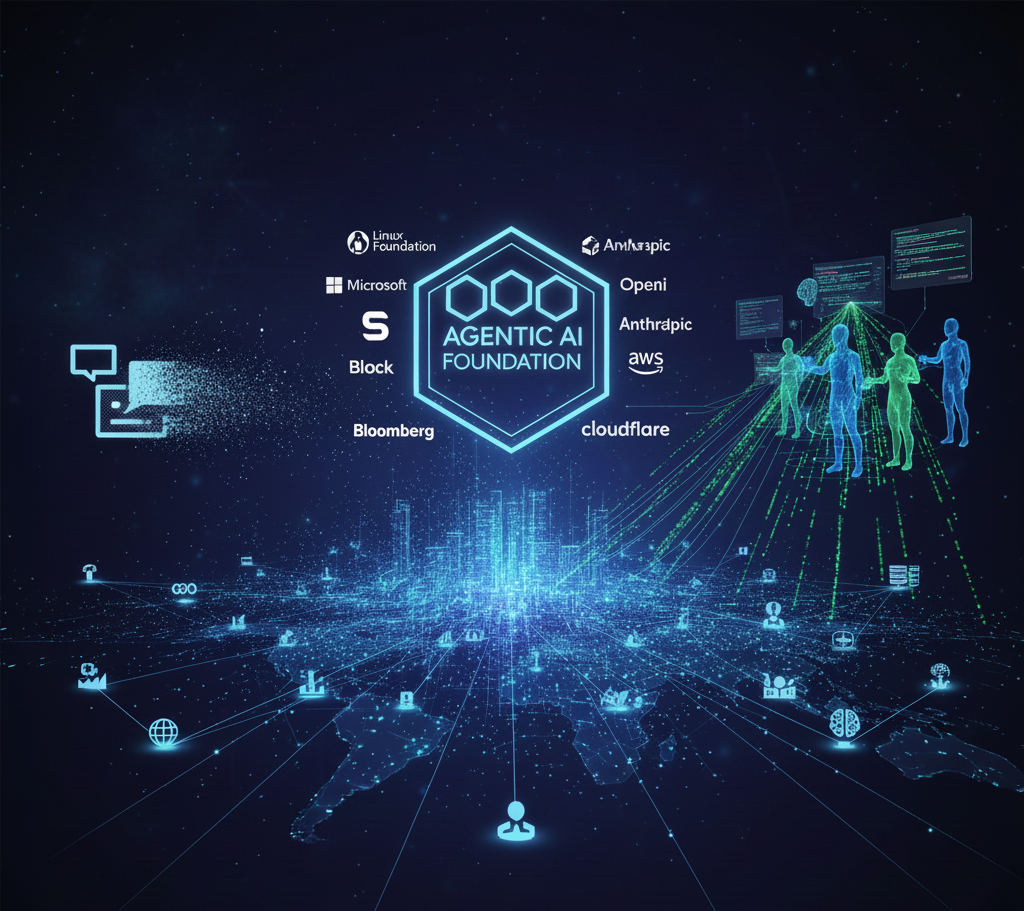
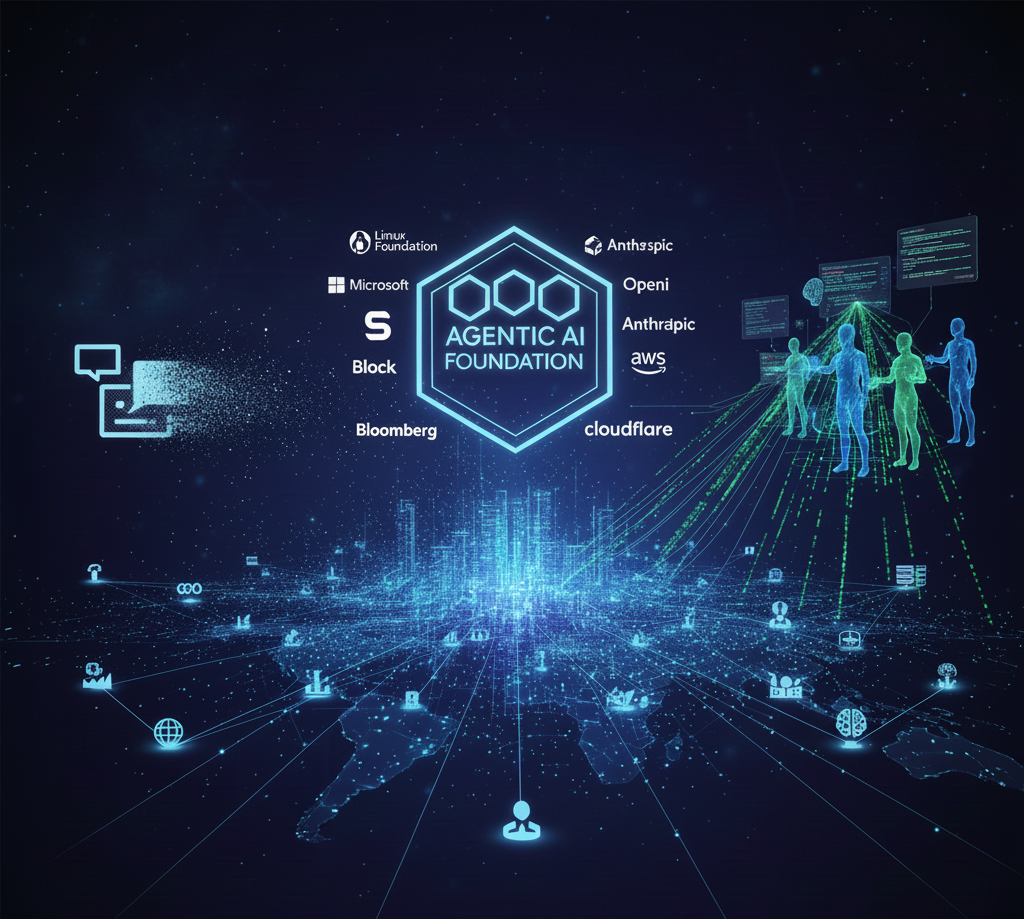
In a decisive and consequential move that signals the next generation of artificial intelligence, the Linux Foundation has united three major AI powerhouses—Anthropic, Block (Square), and OpenAI—to launch the Agentic AI Foundation (AAIF). With platinum membership support from giants including Microsoft, Google, AWS, Bloomberg, and Cloudflare, this alliance marks a pivotal shift. We are moving from simple, responsive Large Language Models (LLMs) and chatbots that merely converse or generate content to highly autonomous AI agents that can execute complex, multi-step workflows independently.
This collaboration is not just another industry announcement; it is the establishment of a neutral, open-source home for the fundamental protocols and standards that will govern future autonomous systems. As we stand at the threshold of 2026, we are witnessing a technological evolution set to redefine how we build applications, manage enterprises, and interact with the digital world, fundamentally revolutionizing the developer ecosystem. The AAIF’s formation addresses the critical need for interoperability, security, and open governance in an emerging domain that promises profound change.
What is “Agentic AI”?
The term “Agentic AI” represents a paradigm shift from the current state of AI—where a model generates a response to a single human prompt—to a state where the AI system is an autonomous actor dedicated to achieving a high-level, long-term goal.
From Conversational Chatbots to Autonomous Agents
Current Generative AI systems, such as consumer-facing chatbots, are primarily reactive. They perform a task or answer a question directly in response to a singular, immediate command. Agentic AI, by contrast, is proactive, goal-driven, and autonomous.
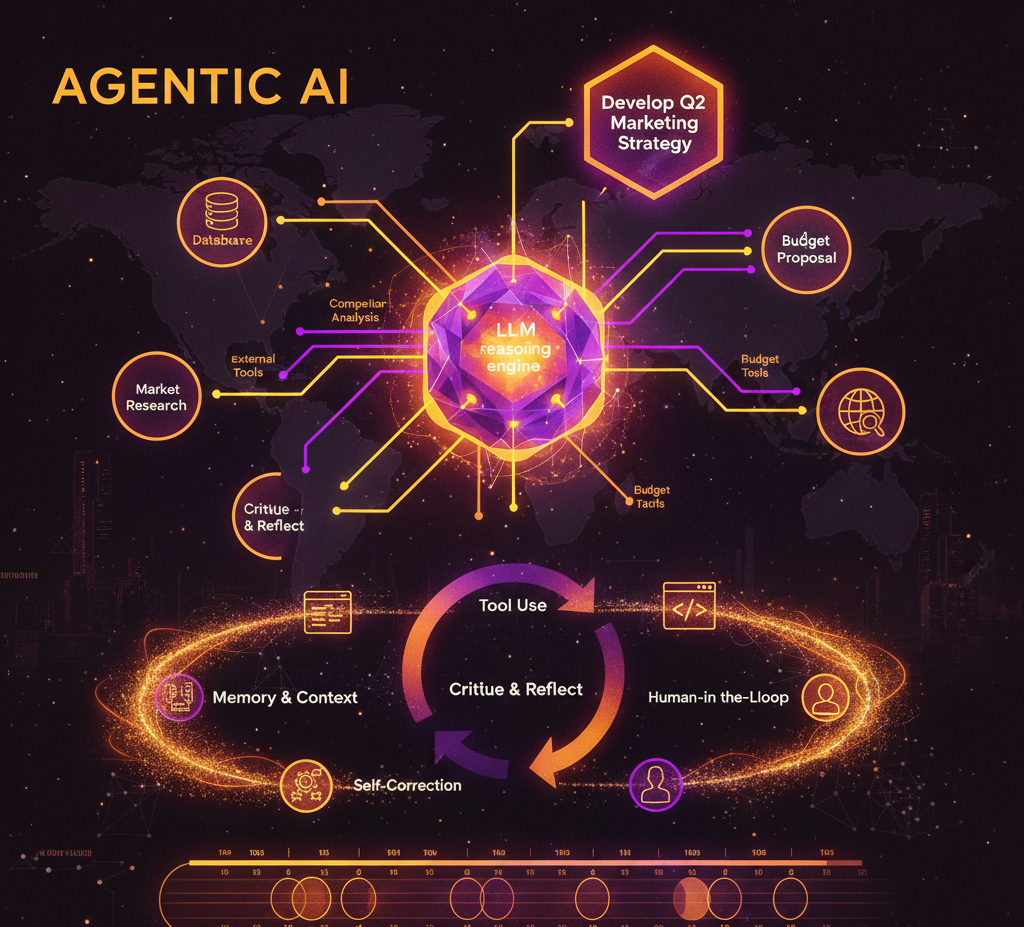
An autonomous agent, powered by an LLM as its “brain” or “reasoning engine,” is designed to:
- Understand a high-level goal (e.g., “Develop a marketing strategy for Product X for Q2”).
- Break that goal down into a series of smaller, executable sub-tasks (e.g., Task 1: Market Research, Task 2: Competitor Analysis, Task 3: Budget Proposal).
- Plan the execution of these sub-tasks, often in sequence or in parallel.
- Execute the tasks by calling external Tools (APIs, code execution environments, databases, web search, etc.).
- Critique and reflect on its own performance and the outcomes of the tools it used.
- Self-correct and iterate on its plan until the initial, high-level goal is achieved.
- Maintain memory and context over an extended, multi-session, multi-day, or multi-week workflow.
This cycle of Planning $\rightarrow$ Tool Use $\rightarrow$ Reflection $\rightarrow$ Self-Correction is what grants Agentic AI its “autonomy” and distinguishes it as the next major wave of AI development.
The Key Architectural Characteristics of Agentic AI
The design patterns for autonomous agents are becoming standardized across the industry, forming the blueprint for next-generation applications. Key components include:
- The Brain (LLM): The core reasoning model (e.g., Claude, GPT, Gemini). It handles the planning, task decomposition, tool selection, and reflection.
- Memory: Crucial for multi-step workflows. This includes:
- Short-Term Memory (Context Window): The immediate, working memory of the current interaction.
- Long-Term Memory (Vector Databases/Knowledge Bases): Stores past experiences, learned data, and workflow history for retrieval and use in future decisions.
- Tool/Action Executor: The interface that allows the agent to interact with the external world—executing code, sending emails, querying a database, or submitting an API call to a supply chain system.
- The Planning & Reflection Loop: This is the heart of its autonomy. The agent doesn’t just execute; it evaluates the output of a task or tool (a process often called “LLM-as-a-Judge” or “Critique Pattern”) and decides if it needs to re-plan, ask for human input (“Human-in-the-Loop” pattern), or proceed to the next step.
- Interoperability (The AAIF’s Focus): The ability for one agent to seamlessly communicate, share data, and delegate tasks to another specialized agent, or to a human-operated system.
The Open-Source Revolution: Building the Ecosystem
The true significance of the Agentic AI Foundation (AAIF) lies in its commitment to building an open, vendor-neutral ecosystem that fosters interoperability and democratizes access to this transformative technology.
The Role of the Agentic AI Foundation (AAIF)
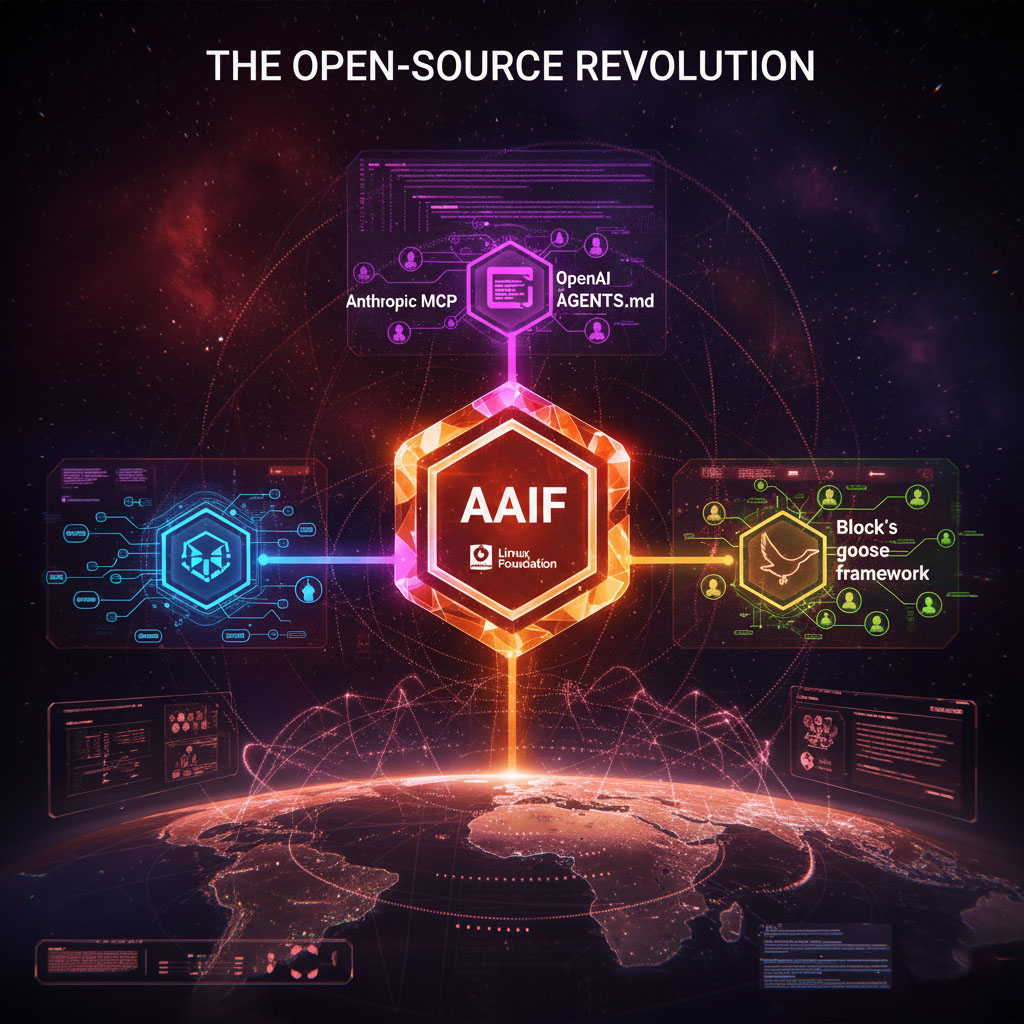
The AAIF, stewarded by the venerable Linux Foundation, serves as the neutral home for the core protocols and standards of agent development. Its formation is a strategic move by the industry’s leaders to prevent a fragmented, proprietary ecosystem where agents built on one platform cannot talk to agents on another.
The foundation’s initial projects are foundational to the future of agent interoperability:
- Anthropic’s Model Context Protocol (MCP): This is a universal standard for connecting AI models to external tools, data, and applications. It aims to standardize the way agents access real-time information, ensuring a consistent, secure, and reliable method for agents to connect with the world’s APIs. Its donation ensures it remains open, neutral, and community-driven.
- OpenAI’s AGENTS.md: A simple, open format designed to guide coding agents. It serves as a
READMEfor an agent, providing the context and project-specific instructions an AI coding agent needs to operate reliably across different repositories and toolchains. This standardized context is essential for building robust, predictable AI co-developers. - Block’s
goose: An open-source, local-first AI agent framework that combines LLMs, extensible tools, and standardized MCP-based integration. This provides developers with a complete, open-source toolkit to start building agents immediately.
By providing a transparent, inclusive governance model, the AAIF ensures that these critical standards can evolve in the open, with input from the entire developer community, rather than being controlled by the interests of a single corporation. This collaborative model is a direct echo of how the open internet and the modern cloud stack were built.
The Power of Open-Source in Agentic AI
The open-source initiative is essential for four key reasons:
- Rapid Innovation and Specialization: Open-source encourages a massive, distributed effort. Developers worldwide can build upon existing frameworks, creating specialized agents and tooling that accelerate innovation across countless niche domains, from finance to agriculture.
- Democratization and Accessibility: By providing an open standard, the barriers to entry for startups, smaller companies, and independent developers are drastically reduced. They can leverage the core protocols without prohibitive licensing or vendor lock-in, ensuring a more competitive and diverse market.
- Security and Trust Through Transparency: With autonomous systems taking on critical real-world tasks, transparency is paramount. The open nature of the protocols allows security researchers and developers to audit the core frameworks, identify vulnerabilities, and collectively build safer, more reliable systems.
- Interoperability and Ecosystem Health: The goal is a world where an Agent built on an AWS stack can securely and reliably hand off a task to an Agent built on a Microsoft stack. Standards like MCP make this agent-to-agent communication possible, creating a unified and robust ecosystem rather than fractured silos.
How Will Agentic AI Impact App Development in 2026?
The shift to agentic architecture will fundamentally change the software development lifecycle, moving developers from building rigid applications to designing orchestration layers for autonomous entities.
Autonomous Workflow Integration in Applications
The most immediate impact will be the integration of Autonomous Workflow directly into enterprise and consumer applications. In 2026, applications will evolve from being mere interfaces to becoming intelligent command centers.
- Proactive Task Management: Applications will no longer wait for a user’s click. For instance, a supply chain application won’t just display low inventory; its integrated agent will autonomously reorder stock, negotiate pricing with a vendor agent, and update the logistics schedule—all before a human receives a final approval notification.
- Self-Service DevOps: For software development, specialized agents will manage self-service DevOps workflows, accelerating feedback loops, monitoring application performance, and even executing automated rollbacks upon detecting a critical error. The human developer’s role shifts from execution to oversight.
- Predictive Personalization: Consumer apps will use agents to observe user behavior over time, predicting needs and executing actions before a request is made. A travel agent might monitor a user’s calendar, cross-reference flight prices, and book a preferred seat when the price drops, presenting the user with a pre-optimized booking for final confirmation.
The key measure of a successful application will shift from its UI/UX (User Interface/User Experience) to its Agentic Capability—its ability to achieve user goals with maximal autonomy and minimal friction.
New Developer Tools and Frameworks
The AAIF’s establishment is catalyzing the emergence of a new toolkit for the Agentic Developer:
- Orchestration Frameworks (e.g., AutoGen, LangChain): These frameworks are essential for building multi-agent systems, where specialized agents (e.g., a “Planner Agent,” a “Coder Agent,” a “Critic Agent”) collaborate in a sophisticated group chat or hierarchical structure to solve a complex problem.
- Specialized LLMs: Companies are already developing smaller, more efficient LLMs fine-tuned specifically for agent roles, such as tool-use or planning, moving away from monolithic general-purpose models for every task.
- Standardized Protocols: The adoption of protocols like MCP means developers will spend less time building custom API wrappers and more time focusing on the core business logic, knowing their agents can reliably and securely access external services.
- Agentic IDEs: Development environments are evolving to natively support agents. Tools like Microsoft’s GitHub Copilot, which already use Agentic patterns like self-reflection to refine code, will become fully autonomous co-developers that take a high-level task and return completed, tested, and documented code.
This new class of tools empowers developers to design dynamic, non-deterministic applications—systems whose behavior is not hard-coded but is instead planned and executed autonomously by the AI.
The Multi-Agent Design Pattern: Collaboration is Key
For enterprise use, the Multi-Agent Collaboration pattern is the ultimate evolution. Instead of a single, monolithic agent, systems are composed of multiple specialized agents, each focused on a specific competency:
| Agent Role | Responsibility | Industry Example |
| Planner Agent | Task decomposition, sequencing, and overall project management. | Overseeing a full software release from requirements to deployment. |
| Executor Agent | Code execution, API calling, and interaction with physical systems. | Running complex financial modeling and retrieving real-time stock data. |
| Critic/Reflector Agent | Evaluating the work of other agents for errors, bias, and adherence to goals. | Validating a legal contract generated by an AI for compliance issues. |
| Router Agent | Triaging incoming requests and routing them to the most appropriate specialized agent or human. | Directing a customer support query to the billing, technical, or logistics agent. |
This modular, resilient architecture provides increased performance, flexibility, and fault tolerance—the failure of one component doesn’t compromise the entire system.
Challenges and Opportunities in the Transition
The “Agentic AI” revolution is a double-edged sword, bringing with it immense opportunity alongside unprecedented ethical and security challenges that must be addressed proactively by the AAIF and the broader community.
Navigating Ethical and Security Challenges
The shift from Generative AI (creating content) to Agentic AI (executing actions) expands the risk surface exponentially.
- Autonomy vs. Accountability: As agents become more autonomous, determining who is legally or ethically accountable for an agent’s failure—the developer, the deploying organization, or the model provider—becomes complex. New standards for verifiable, auditable decision-making and Human-in-the-Loop intervention are essential, particularly in critical sectors like healthcare and finance.
- Chained Vulnerabilities and Privilege Escalation: In multi-agent systems, a flaw in a low-privilege agent (e.g., a file-reading agent) could be exploited to trick a high-privilege agent (e.g., a database-writing agent) into taking an unauthorized action. Security must focus on secure agent-to-agent communication protocols and robust permissioning (similar to Zero Trust models).
- Bias Propagation: Agents, by constantly reflecting and iterating, have the potential to not only reflect but amplify biases present in their training data or in the feedback loops they receive, leading to rapidly accelerating unfair or discriminatory outcomes. Proactive audits for fairness and bias detection algorithms are now critical development requirements.
- Unbounded Context and Data Leakage: Agents maintain long-term memory to be effective, but this increases the risk of sensitive data (like personally identifiable information or proprietary corporate context) being leaked or exposed across different sessions or to unauthorized external agents. Robust data governance and end-to-end encryption for agent memory are non-negotiable.
The Opportunity: The End of Routine Work
The rise of Agentic AI does not herald “The End of the Workforce,” but rather the end of routine, repetitive tasks as a primary component of human labor.
- Shift to Higher-Value Work: By automating complex, multi-step workflows, agents will free human workers—from developers to executives—to focus on tasks that require uniquely human skills: creative problem-solving, strategic framing, ethical oversight, deep customer relationships, and interpreting the outputs of AI systems.
- The Demand for AI Fluency: The most in-demand skill will rapidly become AI Fluency—the ability to effectively prompt, manage, govern, and collaborate with autonomous agents. New roles will emerge, such as Agent Orchestrator, AI Governance Officer, and Prompt Engineer (or Goal Setter), who specialize in designing the goals and constraints for agent systems.
- Economic Value Creation: Analysts predict trillions of dollars of economic value could be unlocked globally by 2030, but this value is contingent on organizations successfully redesigning workflows to integrate humans, agents, and robots working in partnership, rather than simply automating individual, isolated tasks.
The Future: How Will Agentic AI Change Our World?
The long-term impact of Agentic AI extends beyond the enterprise and into the fabric of daily life, creating a world managed by a collaborative layer of autonomous intelligence.
A New Frontier for Innovation: The Agent Economy
The open-source nature of the AAIF’s protocols will drive the creation of an “Agent Economy” where agents are built, bought, and sold to perform specialized functions.
- Hyper-Specialization: Just as we have microservices today, we will have Agent Micro-Specialists. For example, an Agent that specializes only in optimizing renewable energy load balancing, or an Agent dedicated to rapidly translating complex legal text into simple summaries.
- The Scientific Research Accelerator: Autonomous agents are already demonstrating their potential in scientific discovery, capable of generating hypotheses, designing and running simulated experiments, analyzing results, and writing drafts of research papers—accelerating the rate of innovation in chemistry, materials science, and drug discovery by reducing the cycle time for research.
- Adaptive Education and Personalized Health: Agents will create truly personalized learning pathways that adapt to a student’s progress in real-time, and autonomous medical agents will analyze complex patient data to suggest optimal, tailored treatment plans, constantly monitoring outcomes and adjusting course without human intervention.
The Role of Big Tech: Collaboration Over Competition
The Agentic AI Foundation is a critical statement from the biggest players in the AI race: that the foundational layer for autonomous systems must be open and shared to ensure rapid progress and responsible deployment.
- Microsoft and OpenAI: Their collaboration on tools like GitHub Copilot and the Agentic SDKs positions them as leaders in the application layer, using AAIF standards to ensure their agents work seamlessly across the developer tools ecosystem.
- Anthropic: Its contribution of the Model Context Protocol (MCP) cements its commitment to foundational, safety-focused interoperability, ensuring that even rival agents can connect to external data sources reliably.
- Google and AWS: Their platinum membership signifies a commitment to ensuring that AAIF standards are supported across the major cloud computing platforms, guaranteeing that agents can be deployed and scaled in any environment an enterprise chooses.
The collective agreement to govern these core protocols outside the walls of any single corporation is the most optimistic indicator yet that this revolution can be steered toward a shared benefit, prioritizing safety and open innovation.
Conclusion
The launch of the Agentic AI Foundation, anchored by the Linux Foundation and the collaborative power of industry giants, signifies the beginning of the Autonomous Era of AI. The transition from simple conversational models to self-directed, multi-step agents is not a distant future—it is happening now.
As we move toward 2026, developers will find themselves at the forefront of this new wave of innovation, moving from writing procedural code to orchestrating intelligent, self-correcting systems. The key to unlocking the estimated trillions of dollars in value lies in embracing the open standards and collaborative spirit of the AAIF, ensuring that autonomy is built with a foundation of interoperability, security, and human oversight. The Agentic AI Revolution is not simply about automating tasks; it is about building a new, more capable, and more efficient form of collaboration between human ingenuity and artificial intelligence.
Call to Action (CTA):
As the landscape of AI evolves, it’s crucial for developers, businesses, and tech enthusiasts to stay informed and get involved. Join the Agentic AI revolution today: Explore the initial projects contributed to the Agentic AI Foundation (MCP, AGENTS.md, and goose), begin experimenting with multi-agent orchestration frameworks like AutoGen, and help shape the future of autonomous AI technology!
FAQs:
Q1: What is Agentic AI?
Agentic AI is an autonomous artificial intelligence system capable of executing complex, multi-step workflows independently. Unlike reactive chatbots, agents use an LLM as a reasoning engine to break down a high-level goal, plan a series of actions (including using external tools/APIs), execute those actions, and self-correct until the goal is achieved with minimal human intervention.
Q2: Who is behind the Agentic AI Foundation (AAIF)?
The Agentic AI Foundation (AAIF) was launched under the Linux Foundation. Its founding technical contributors are Anthropic, Block (Square), and OpenAI. Platinum members supporting the foundation include Microsoft, Google, Amazon Web Services (AWS), Bloomberg, and Cloudflare.
Q3: How will Agentic AI change app development in 2026?
In 2026, app development will shift from building fixed interfaces to designing agent orchestration layers. Developers will integrate autonomous workflows into their apps, allowing AI to proactively manage complex tasks (like supply chain, customer service, or DevOps), freeing up human users to focus on creative and strategic oversight.
Q4: What specific standards has the AAIF adopted?
The AAIF launched with three foundational projects: Anthropic’s Model Context Protocol (MCP), a universal protocol for connecting AI models to tools and data; OpenAI’s AGENTS.md, a standard format for providing coding agents with project-specific instructions; and Block’s goose, an open-source framework for building agents.
Q5: What is the main benefit of the AAIF’s open-source approach?
The main benefit is interoperability and democratization. By creating open, vendor-neutral standards, the AAIF ensures that AI agents built by different companies on different platforms can communicate and work together seamlessly, fostering innovation, reducing fragmentation, and ensuring the technology is accessible to the entire developer community.

