Table of Contents
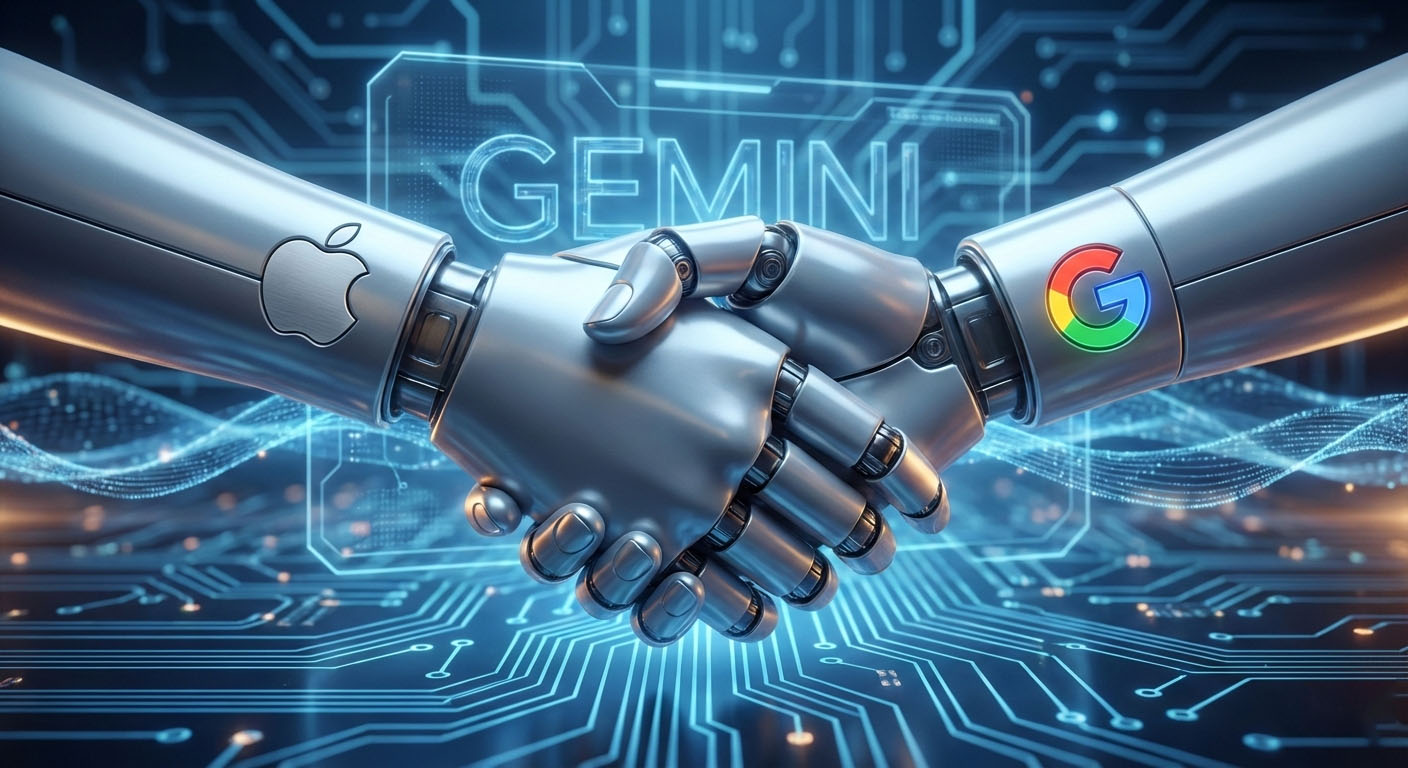
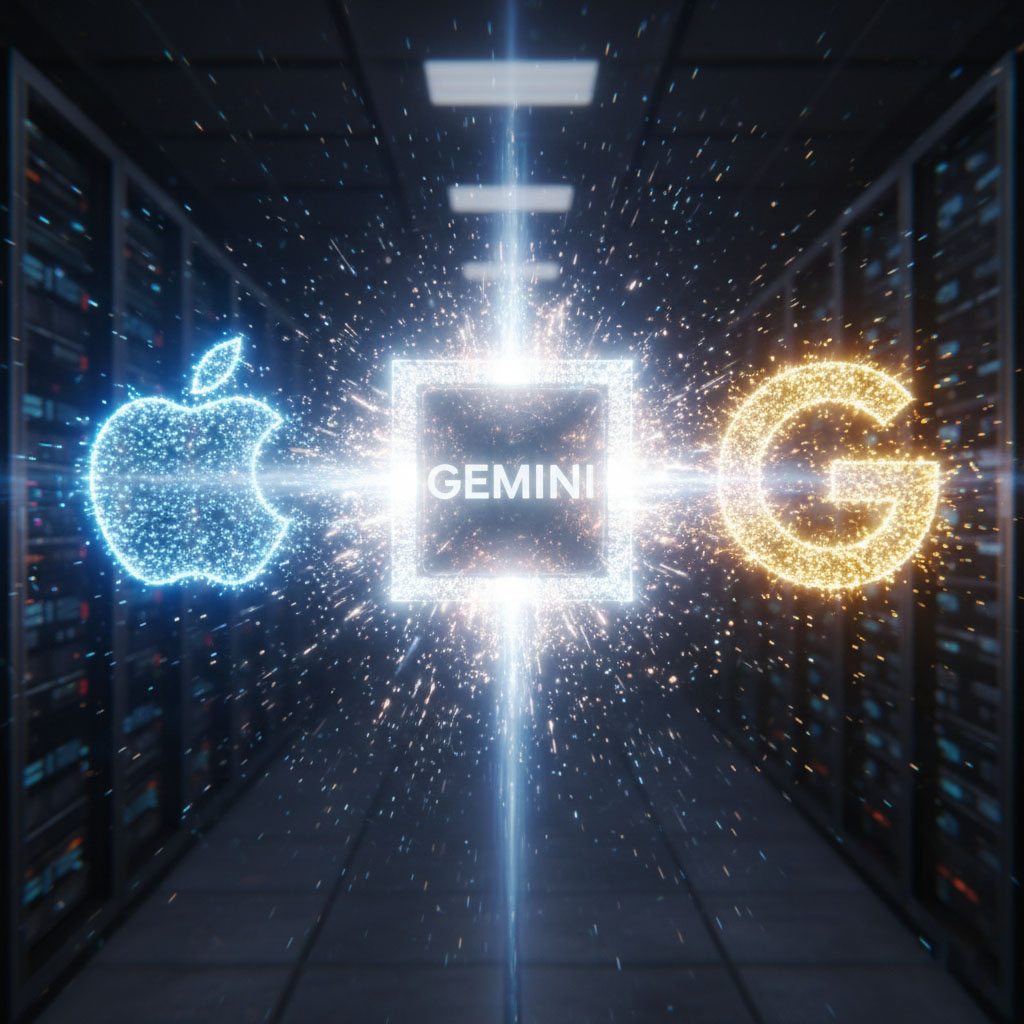
On January 12, 2026, the technology landscape underwent a seismic shift that few predicted when the generative AI boom began. Apple and Google—two companies that have spent the better part of two decades as the fiercest of rivals—announced a multi-year, multi-billion dollar agreement to integrate Google Gemini AI into the core of the Apple ecosystem.1
This move effectively ends Apple’s brief, highly publicized “honeymoon” with OpenAI and signals a new era for Apple Intelligence.2 The partnership isn’t just a software update; it is a fundamental re-architecting of how over two billion active devices will process thought, intent, and action.
Introduction: Why the Apple Google Gemini Partnership Is Massive News
The announcement of the Apple Google Gemini Partnership has sent shockwaves through Silicon Valley, not just because of the names involved, but because of what it says about the state of the AI race in 2026.
The End of the “OpenAI Stop-Gap”
When Apple first introduced Apple Intelligence at WWDC 2024, the integration of ChatGPT was presented as a high-end “plugin” for users who needed more than what Siri could provide. In hindsight, analysts now see that as a stop-gap measure. As of January 2026, Apple has decided that for its “Foundation Models”—the very DNA of its operating systems—it requires a partner with deeper infrastructure and more stable long-term alignment.3
A $4 Trillion Valuation Milestone
The markets reacted instantly. Following the news, Alphabet (Google’s parent company) saw its market capitalization surge past the $4 trillion mark for the first time.4 For Apple, the deal provides a clear roadmap out of the “AI laggard” narrative that has dogged the company for years.5 By leveraging Google’s Gemini 3 architecture, Apple is essentially “renting” the world’s most powerful neural network to fuel its next decade of hardware sales.+1
The New “Default” for Mobile AI
This partnership cements Gemini as the definitive engine for mobile intelligence. With Gemini already powering Samsung’s “Galaxy AI” and now Apple’s “Apple Intelligence,” Google has achieved a level of distribution dominance that even Microsoft-backed OpenAI cannot match.
Apple’s Breakup with OpenAI – What Really Happened?
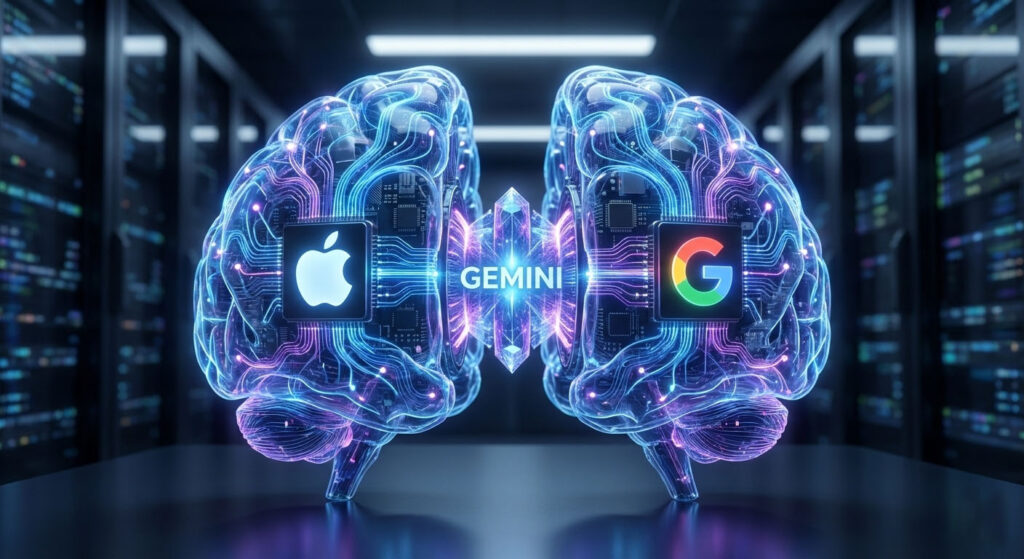
To understand the Apple Google Gemini Partnership, one must first look at the crumbling of the Apple-OpenAI alliance. What began as a strategic partnership in 2024 turned into a series of philosophical and competitive conflicts by late 2025.
Strategic Friction and the Jony Ive Factor
The primary catalyst for the “breakup” was the shifting nature of OpenAI itself. Throughout 2025, OpenAI moved from being a “model lab” to a “hardware and platform competitor.” The most significant blow to the relationship was OpenAI’s collaboration with legendary former Apple designer Jony Ive to build a dedicated AI hardware device. Apple, protective of its hardware dominance, reportedly saw this as OpenAI attempting to build an “iPhone killer” powered by GPT-6.
The “ChatGPT Atlas” Browser Conflict
In late 2025, OpenAI released the Atlas Browser, an AI-native web browser designed to replace the traditional search-and-click experience.6 By entering the browser space, OpenAI became a direct competitor to Safari. Apple’s leadership, led by CEO Tim Cook and Software Chief Craig Federighi, realized that relying on a competitor for their core intelligence layer was a strategic liability.
Reliability and Scaling Issues
While GPT-5 was a landmark model, Apple Google Gemini Partnership struggled with “inference costs” and reliability at the scale Apple required. Apple needed 99.99% uptime for two billion users. Google’s globally distributed data centers and custom TPU (Tensor Processing Units) offered a level of industrial-scale reliability that OpenAI’s reliance on Microsoft’s Azure cloud simply couldn’t guarantee at the time.
What Is Google Gemini? A Deep Dive into Google’s Most Powerful AI
At the heart of the Apple Google Gemini Partnership is Google’s most advanced AI architecture to date: Gemini 3.7
Native Multimodality: The Secret Sauce
Unlike previous AI models that “stitched” together separate vision, text, and audio components, Gemini was built from the ground up as a native multimodal model.8 This means it processes video, images, and text simultaneously in a single transformer stack.9 This is crucial for Apple’s “Visual Intelligence” features, where an iPhone user might point their camera at a complex object and ask Siri to “Explain how to fix this using the tools I have in my garage.”+1
Gemini 3 Pro and the “Deep Think” Mode
Gemini 3 introduced a revolutionary “Deep Think” mode, which allows the model to run internal chains of thought before responding.10 In benchmarks like the GPQA Diamond (a test of PhD-level reasoning), Gemini 3 Pro scored an unprecedented 91.9%, surpassing GPT-5.1.11+1
[Image comparing Google Gemini 3 and GPT-5 benchmarks]
The “Nano Banana” Integration
A unique aspect of the deal involves Nano Banana, Google’s state-of-the-art image and video generation model.12 By integrating this into Apple’s “Image Playground,” Apple users can now generate 8-second high-fidelity video clips with sound natively within Messages—a feature that previously required third-party apps or high-latency cloud connections.
Apple Intelligence Explained: Apple’s New AI Ecosystem
The Apple Google Gemini Partnership is the “brain” transplant that Apple Intelligence needed to reach its full potential.13 Apple Intelligence is not a single app; it is a system-wide layer of intelligence that sits between the hardware (Apple Silicon) and the software (iOS/macOS).
The Hybrid AI Model
Apple’s strategy remains “Privacy-First,” which necessitates a hybrid approach:14
- On-Device Processing: Simple tasks like text summarization, notification prioritization, and basic photo editing are handled by Apple’s own small-language models (SLMs) running on the A19 and M5 chips.
- Private Cloud Compute (PCC): For more complex reasoning, Apple uses its own custom-built servers running Apple Silicon.
- The Gemini Layer: For “frontier-level” queries—tasks requiring world knowledge or complex multi-step planning—the request is handed off to Google’s Gemini 3 models via a secure, anonymized pipeline.
Private Cloud Compute: The Trust Bridge
The deal’s success hinges on Private Cloud Compute.15 Apple has built a system where even Google cannot “see” the data being sent to Gemini. When a user asks a complex question, the data is stripped of all personal identifiers, encrypted, and processed in a “stateless” environment. No data is ever stored by Google for training purposes, satisfying Apple’s stringent privacy mandates.
How Gemini Will Power Siri’s Next Generation
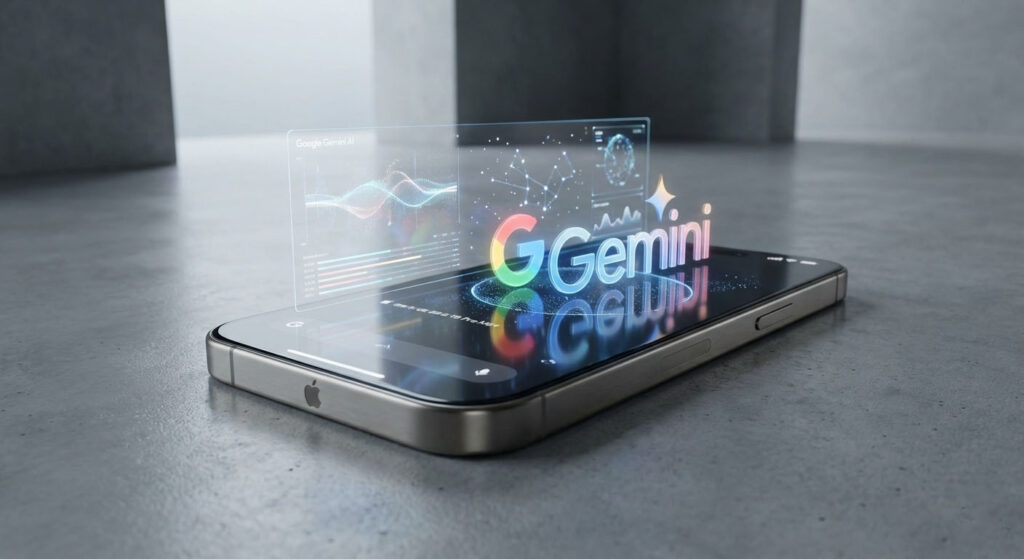
The most visible result of the Apple Google Gemini Partnership is the complete “rebirth” of Siri. For over a decade, Siri was criticized for being rigid and “dumb.” In the Spring 2026 update, Siri is becoming a true Agentic AI.
Contextual Awareness Across Apps
Powered by Gemini’s massive 2-million-token context window, the new Siri can “remember” and “understand” everything on your screen and in your history.
- Example: You can say, “Siri, find the email from my landlord about the rent increase, compare it to my budget spreadsheet in Numbers, and draft a polite negotiation response based on the local tenant laws Gemini knows about.”
Multi-Step Reasoning
Previously, Siri could only handle one command at a time. With Gemini 3’s agentic capabilities, it can execute complex workflows.16 It can book a flight, add the itinerary to your Calendar, notify your spouse via iMessage, and set a reminder to pack your bags—all from a single voice prompt.
Visual Intelligence 2.0
With the Apple Siri AI upgrade, the iPhone’s camera becomes an “eye” for Gemini. Users can take a screenshot of a complicated graph in a research paper and ask Siri to “Explain this like I’m five years old and find three related articles in Safari.” Because Gemini excels at ScreenSpot-Pro benchmarks (achieving 72.7% accuracy in screen understanding), it can navigate UI elements better than any previous assistant.17
Gemini Integration in iOS, iPadOS, and macOS
The Apple Google Gemini Partnership goes beyond voice. It is embedded into every corner of the 2026 software lineup.
Writing Tools and “Style Transfer”
Apple’s Writing Tools now leverage Gemini’s superior linguistic capabilities. Beyond simple proofreading, users can use “Dynamic Rewriting.” You can write a rough draft of a resignation letter and tell your Mac to “Rewrite this to sound more professional but slightly regretful, and ensure it follows the standard corporate format used in the UK.”
Image Wand and “Video Playground”
On the iPad, the Image Wand (a tool that turns sketches into art) now uses Gemini’s multimodal understanding to interpret “intent.” If you sketch a rough circle and write “medieval castle,” Gemini doesn’t just draw a castle; it understands the historical context and artistic style you’ve been using in your previous notes to create a cohesive piece of art.
Smart Mail and Priority Notifications
The integration allows for Semantic Sorting of emails. Instead of just showing “Priority” based on the sender, Gemini reads the content to understand urgency. It can flag an email as “Urgent” because it mentions a “missed deadline” or a “flight delay,” even if it’s from an unknown sender.
Why Apple Chose Google Over OpenAI
The decision to pivot toward the Apple Google Gemini Partnership was based on three pillars: Infrastructure, Innovation, and Interoperability.
Pillar 1: Vertical Integration (TPUs vs GPUs)
Google designs its own AI chips (TPUs). This vertical integration allows for much lower latency and higher efficiency than OpenAI, which has to compete for expensive Nvidia H100/H200 GPUs. For Apple, this means faster response times for Siri and lower costs for the “Apple Intelligence” subscription tiers.
Pillar 2: Research Supremacy
Google DeepMind, the lab behind Gemini, has a decades-long track record of breakthrough research. While OpenAI revolutionized the world with ChatGPT, Google has led the way in “Agentic AI” and “Infinite Context.” Apple determined that Google’s research roadmap for 2026–2030 was more aligned with Apple’s vision for “Ambient Computing.”
Pillar 3: The Search Relationship
Apple and Google already have a massive financial relationship through the Search deal (where Google pays Apple ~$20 billion annually).18 Integrating Gemini was a natural extension of a pre-existing multi-decade alliance. It was easier for legal and compliance teams to “expand” an existing contract than to build a new one with a volatile startup like OpenAI.
Financial Details: Inside the Multi-Billion Dollar Deal
While the exact numbers are closely guarded, analysts from Deepwater Asset Management and Financial Times have pieced together the structure of the Apple Google Gemini Partnership.19
The Licensing Structure
Apple is reportedly paying Google a licensing fee of approximately $1 billion to $5 billion per year. This is a significant reversal of the Search deal; here, Apple is the customer, and Google is the provider.
Revenue Sharing and “AI Search”
A key component of the deal involves the future of search.20 As users move away from “Google Search” toward “AI Answers,” Apple and Google have agreed on a revenue-sharing model for “Sponsored Insights.” If Gemini suggests a product during a Siri conversation and the user buys it, both companies share the affiliate revenue.
Infrastructure Offloading
By partnering with Google, Apple avoids the $90 billion annual capital expenditure that Microsoft and Google are currently spending on data centers. This allows Apple to maintain its high profit margins while still offering cutting-edge AI features.
Data Privacy & User Security Concerns
The biggest hurdle for the Apple Google Gemini Partnership is the public perception of Google as a “data company.” Apple has spent years marketing itself as the protector of privacy against “Big Tech” data miners.21
How Apple Protects the User
- On-Device Anonymization: Your “Personal Index” (your emails, messages, and photos) stays on your iPhone.22 Only the “logic” of a query is sent to Google.
- No Training Clause: The contract explicitly forbids Google from using Apple user queries to train future versions of Gemini.
- Third-Party Auditing: Apple has allowed independent security researchers to audit the “Private Cloud Compute” nodes to prove that no data leakage is occurring.
The “Siloed Intelligence” Approach
Apple uses a technology called Differential Privacy. This adds “mathematical noise” to the data sent to Google, making it impossible for Google to reconstruct the identity of the user, even if they had the keys to the encryption.
Gemini vs OpenAI: Head-to-Head Comparison
In the 2026 AI landscape, the competition between Gemini vs OpenAI is the new “Mac vs PC.”
| Feature | Google Gemini 3 (Apple Partner) | OpenAI GPT-5.1 |
| Reasoning (GPQA) | 91.9% | 88.1% |
| Multimodality | Native (Unified) | Stitched Encoders |
| Context Window | 2 Million+ Tokens | 1 Million Tokens |
| Video Processing | Native Temporal Logic | Frame-by-Frame |
| Edge Performance23 | Optimized for Apple Silicon24 | Primarily Cloud-based25 |
While OpenAI’s models are often praised for their “creative flair” and “vibe coding” abilities, Apple prioritized Gemini’s groundedness and spatial reasoning. For a system-level assistant that needs to interact with the real world (via the camera) and the user’s data (via the file system), Gemini’s native multimodality was the deciding factor.
Impact on iPhone Users Worldwide
For the average consumer, the Apple Google Gemini Partnership means the iPhone 17 and iPhone 18 will feel less like “smartphones” and more like “personal secretaries.”
The “No-App” Era
We are entering an era where users spend less time inside apps. If Gemini can “see” your apps, you can simply tell Siri to “Order my usual Starbucks to my current location and pay with Apple Pay.” You never have to open the Starbucks app. This changes the mobile user experience from “App-Centric” to “Intent-Centric.”
Global Language Support
One of Google’s greatest strengths is its multilingual database. The Gemini integration brings Live Translation to the AirPods Pro 3, allowing for near-instant, natural-sounding translation during phone calls and face-to-face meetings in over 120 languages.
Accessibility Breakthroughs
For users with visual or motor impairments, the Gemini-powered Siri is a life-changer. It can describe what is on the screen with 99% accuracy, allowing users to navigate complex web pages or apps that weren’t built with accessibility in mind.
Impact on Developers and the Apple Ecosystem
The Apple Google Gemini Partnership has sent a clear message to the developer community: “Adapt or be disrupted.”
The SiriKit Overhaul
Apple has released a new set of APIs called “Intent Intelligence.” Developers no longer need to manually map out every voice command. They simply provide “semantic descriptions” of what their app can do, and Gemini figures out how to trigger those actions based on the user’s natural language.
The Threat to “Wrapper” Apps
Thousands of startups that built “AI PDF Summarizers” or “AI Photo Editors” are now facing an existential crisis. When Gemini is baked into the OS for free (or as part of iCloud+), the value proposition of a $20/month third-party AI app disappears.
New Opportunities in “Agentic Workflows”
Conversely, a new category of “Agent-Ready” apps is emerging. Developers are building “plugins” for the Gemini-Siri layer, allowing the AI to perform specialized tasks like “Professional Legal Auditing” or “Complex Medical Diagnosis” using the app as a secure data vault.
What This Means for the Future of AI
The Apple Google Gemini Partnership signifies the “Consolidation Phase” of the AI revolution.
The AI Duopoly
We are effectively witnessing the birth of an AI duopoly:
- The Microsoft-OpenAI-Nvidia Camp: Focused on Enterprise, Coding, and High-End Creative.
- The Apple-Google-Samsung Camp: Focused on Consumer, Mobile, and Ambient Intelligence.
This consolidation makes it harder for small AI startups to compete at the foundational level. The “moat” is no longer just the model; it’s the distribution (Apple’s 2 billion devices) and the compute (Google’s TPUs).
AI as a Utility
By integrating Gemini so deeply, Apple is treating AI like “electricity” or “Wi-Fi”—a fundamental utility that should just “work” in the background. We are moving away from “chatting with an AI” and toward “living with an intelligence.”
How This Partnership Changes the AI Industry Landscape
The ripple effects of this deal extend far beyond Apple and Google.26
The Impact on Nvidia
While Nvidia remains the king of AI chips, the Apple-Google deal is a warning. Both companies are increasingly using their own silicon (Apple Silicon and Google TPUs) to run their AI workloads. This reduces their long-term reliance on Nvidia’s expensive H100 chips and could signal a cooling of the GPU “gold rush.”
The Regulatory Microscope
Regulators in the EU and the US are already scrutinizing the deal.27 The concern is that the Apple Google Gemini Partnership creates an “unbreakable” monopoly. If the world’s most popular phone and the world’s most popular AI model are joined at the hip, can anyone else ever break into the market? Elon Musk has already labeled the move an “unreasonable concentration of power.”28+1
Risks, Challenges, and Criticism
No partnership of this magnitude is without its pitfalls.
1. The Hallucination Problem
Even Gemini 3 is not 100% accurate. If a user asks Siri for medical advice or help with a legal contract and Gemini “hallucinates” a wrong answer, who is responsible? Apple’s brand is built on “it just works.” If the AI “just breaks,” the damage to Apple’s reputation could be permanent.
2. The Dependency Trap
By outsourcing its core intelligence to Google, Apple is admitting it cannot build frontier models alone.29 This creates a “dependency trap.” If Google decides to raise prices or if their relationship sours, Apple has no immediate “Plan B.”
3. Cultural Clash
Apple is a “secretive, slow, and polished” company. Google is a “move fast, release beta, and iterate” company. Reconciling these two corporate cultures into a single, seamless user experience is an immense engineering and management challenge.
Expert Opinions & Industry Reactions
“This is the most pragmatic move in Apple’s history. They realized they couldn’t win the LLM arms race on their own, so they bought the best army available.” — Gene Munster, Deepwater Asset Management.30
“The OpenAI breakup was inevitable once Sam Altman started eyeing hardware. Apple does not tolerate partners who try to occupy the same physical space in the customer’s pocket.” — Hartley Charlton, MacRumors.
“For Google, this is the ultimate ‘vibe check’ victory. After being called ‘behind’ for two years, they are now the engine of the iPhone. That is a checkmate move.” — Sundar Pichai (during the Jan 12 press conference).
Future Roadmap: What’s Next for Apple Intelligence?
The Apple Google Gemini Partnership is just the beginning. The 2026–2027 roadmap includes several groundbreaking milestones:
- iOS 19.4 (Spring 2026): The full rollout of the “Agentic Siri” powered by Gemini 3 Pro.
- macOS “Sequoia” Update: Integration of Gemini-powered “Code Generation” into Xcode, allowing developers to build apps using only voice and high-level descriptions.
- Vision Pro 2 (Late 2026): The first spatial computer built from the ground up for Gemini’s visual reasoning. This will allow the headset to “label” the real world in real-time, providing an AI-augmented overlay of everything you see.
- Apple Watch Series 12: Using “Gemini Nano” for proactive health monitoring—predicting illnesses before symptoms appear by analyzing subtle patterns in heart rate and movement.
Final Thoughts: Is the Apple Google Gemini Partnership a Smart Move?
In the fast-paced world of technology, the Apple Google Gemini Partnership will likely be remembered as the deal that saved the iPhone from irrelevance in the AI age. By choosing Google over OpenAI, Apple prioritized reliability, scale, and multimodality over the hype of the startup world.
For users, the benefits are clear: a Siri that finally works, a device that understands context, and a level of productivity that was previously impossible. For the industry, it is a reminder that in the era of Artificial Intelligence, the biggest winners are those who control both the interface and the infrastructure.
The partnership is a bold bet on a shared future. If successful, it will redefine the relationship between humans and their machines. If it fails, it will be a cautionary tale about the dangers of Silicon Valley consolidation. But for now, as we head into the rest of 2026, the “Treaty of Mountain View” has made one thing certain: the future of AI is no longer a question—it’s an ecosystem.
FAQs
Why did Apple drop OpenAI?
Apple cited the need for a more “capable foundation” for its next-generation models.31 Conflicts over OpenAI’s hardware ambitions and the “Atlas” browser also played a role in the decision to pivot to Google.
What is Google Gemini?
Google Gemini is a family of multimodal AI models.32 The latest version, Gemini 3, handles text, images, video, and reasoning natively, outperforming rivals in most 2026 benchmarks.33+1
How does Gemini power Siri?
While simple tasks stay on the device, complex, multi-step queries are sent to Google’s Gemini 3 models via Apple’s secure Private Cloud Compute servers.34
Is user data safe?
Yes. Apple uses Private Cloud Compute to ensure that all data sent to Google is anonymized and encrypted.35 Google is contractually forbidden from using Apple user data to train its AI.
Can Apple switch AI partners again?
The current deal is multi-year, but Apple’s architecture is “Model Agnostic.” This means Apple could theoretically swap Gemini for another model (like Anthropic’s Claude or its own internal models) if the competitive landscape changes again.

